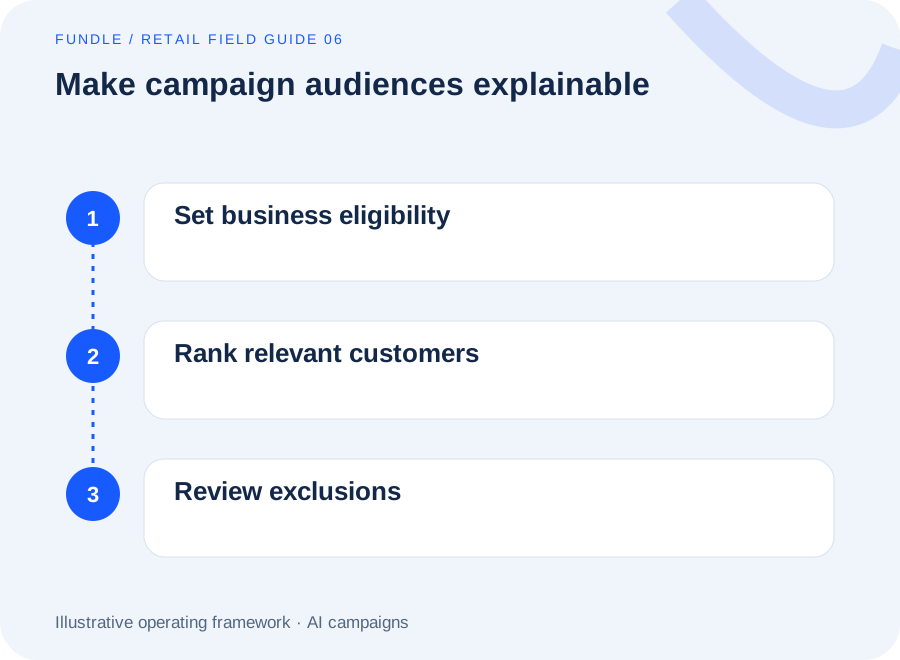
Select AI campaign audiences that are eligible, useful and testable
How should AI help a retail team choose a campaign audience?
Use AI to prioritise a clearly eligible population, not to override permissions, service exclusions or commercial rules. Define the campaign objective, freeze the available customer signals and distinguish purchase likelihood from responsiveness to the proposed action. Select the candidate pool first, then assign a valid comparison group. Evaluate contribution and customer response before expanding the audience or message frequency.
Turn the campaign brief into a selection decision
A useful audience brief names the behaviour the campaign should change. Reactivating a lapsed category buyer, encouraging replenishment and informing a customer about a requested product are different objectives. They require different signals and different reasons to contact someone. A broad instruction to find high-value customers does not provide enough direction.
Specify the action, eligible products, contact channel, timing, budget and success measure. Name the customer problem the message solves. Then ask which information is needed to identify that situation. Historical spend can be useful context, but it should not automatically dominate every campaign simply because it is easy to rank.
Apply hard eligibility gates before scoring
Permissions, unresolved complaints, unavailable products and frequency limits are constraints, not weak preferences that a high model score can outweigh. Build the eligible population first. Record the reason for each exclusion so the team can distinguish customer protection, operational readiness and commercial policy.
Use a fixed data cutoff for the initial selection. Record when transactions, returns and contact history were last refreshed. A shopper who purchased yesterday should not be labelled inactive because one feed is three days late. If freshness differs by store, either repair it or narrow the audience to a clearly described coverage window.
| Gate | Question | Typical operator response |
|---|---|---|
| Applicable permission | Can this message be sent on this channel? | Suppress if not eligible |
| Service context | Is a complaint or return unresolved? | Route to service first |
| Product relevance | Is there evidence of a useful need? | Choose a better message or no contact |
| Availability | Can the offer be fulfilled locally? | Restrict the campaign scope |
| Contact pressure | Has the customer recently received enough messages? | Defer or prioritise another action |
| Data coverage | Is the qualifying behaviour observable? | Flag or exclude incomplete records |
Distinguish likelihood from incremental response
A customer with a high probability of buying may not need a campaign. Conversely, a customer with moderate purchase likelihood may respond strongly to useful information. A propensity score estimates an outcome under the conditions represented in its training data. It does not automatically estimate the additional effect of this particular message or reward.
Begin with interpretable segment rules where experimental evidence is limited. Shopify's customer-report documentation describes recency, frequency and monetary-value analysis as a view of existing shopping behaviour. Treat those measures as descriptive inputs. Whether a segment benefits from a specific intervention remains a separate question to test.
If a proposed model estimates uplift, ask what comparison data supports that estimate and whether the conditions resemble the new campaign. Inspect calibration, sample coverage and uncertainty across relevant groups. A fluent explanation generated after scoring does not establish that the underlying estimate is valid.
Keep the ranked pool and experiment aligned
Select the population to which the decision should apply, then create the treatment and comparison groups within it. Do not send to the highest-scoring customers and compare them with the lowest-scoring customers left over. That design confuses the effect of the campaign with the difference that caused the ranking.
Store the score version, feature cutoff, selection threshold and exclusion rules. If the audience is rebuilt tomorrow, the team should be able to explain why it changed. New transactions may legitimately change eligibility, but silent model or rule updates make operational debugging and campaign measurement unnecessarily difficult.
Worked hypothetical example: build a bounded audience
A retailer starts with 10,000 candidate customers for a category campaign. It excludes 2,000 without the applicable channel permission, leaving 8,000. It then excludes 500 with unresolved service cases, 1,000 without relevant fulfilment coverage and 500 beyond the contact-frequency rule. These sequential, non-overlapping exclusions leave 6,000 eligible candidates.
The team scores those 6,000 using information available before assignment. It chooses a ranked pool of 5,000 for the proposed pilot. Within that same pool, it randomly assigns 4,000 to receive the campaign and 1,000 to retain the existing experience. The remaining 1,000 eligible candidates are outside the pilot, not its control group.
If dispatch costs ₹1.50 per assigned treatment customer, the planned contact cost is 4,000 multiplied by ₹1.50, or ₹6,000. This figure excludes creative, rewards and other costs. It is a planning example, not a supplier price or a Fundle result. The team measures commercial outcomes per assigned customer in the 4,000 and 1,000 groups over the same follow-up period.
This design evaluates the campaign for the selected 5,000-customer pool. It does not establish that the same message works for the excluded customers or for every lower-ranked customer. Broader rollout requires a separate commercial and customer-experience judgement.
Review explanations and exceptions with operators
For a sampled customer, the reviewer should see the qualifying event, applicable rules and the reason this action is relevant now. Avoid explanations that merely restate a score, such as high engagement potential. A useful explanation points to evidence that a human can inspect and correct.
NIST's AI Risk Management Framework supports considering trustworthiness during AI evaluation. Our practical recommendation is to review both included and excluded examples before release, record overrides and track whether recommendations behave differently when data becomes sparse. Avoid using sensitive or inferred personal characteristics when ordinary purchase context can answer the business question.
Audience-release checklist
- State the intended behavioural change and a useful customer proposition.
- Apply permission, service, stock and contact-pressure gates first.
- Label scores accurately as descriptive, predictive or experimentally estimated.
- Record the data cutoff, model version and selection threshold.
- Randomise the comparison within the selected candidate pool.
- Inspect audience samples and approve the final release conditions.
Explore campaign management and Fundle Brain with this selection funnel in hand. Request a Fundle walkthrough of how your operators would inspect a recommendation and its exclusions. Confirm supported data sources, score explanations and activation approvals before relying on the proposed workflow.
Questions from retail teams
Should we always target customers with the highest purchase probability?
Not necessarily. Some highly likely buyers would purchase without additional contact, so an incentive may mainly subsidise existing demand. Match the ranking method to the campaign objective and test the intervention within the selected population. Purchase propensity can help describe likely behaviour, but it is not the same as the incremental effect of a message.
Can AI override a contact-frequency limit for a valuable customer?
A frequency limit should operate as an explicit policy constraint unless an authorised business process changes it. A high score alone should not bypass it. Review competing messages and choose the most useful eligible action, which may be no contact. Keep any approved exception visible so the team can evaluate its effect on customer response.
Why are lower-ranked customers a poor control group?
They differ from the targeted group by design, often on the same characteristics that predict purchasing. Comparing their outcomes therefore mixes campaign effect with selection differences. Choose the intended candidate pool first and assign comparison groups within it. This makes the experiment answer whether the campaign helps customers like those the business actually plans to contact.
What evidence should accompany an AI audience recommendation?
Include the audience definition, data cutoff, qualifying signals, exclusion counts, score meaning and relevant uncertainty. Show examples that operators can inspect, including records close to the selection boundary. Preserve the rule and model versions so a later review can reconstruct the decision instead of depending on a narrative generated after the campaign ran.
How do we handle customers with little purchase history?
Use a deliberately limited approach rather than pretending sparse data supports precise personalisation. A general but relevant service message, an optional preference question or no campaign may be appropriate. Keep these customers identifiable as a separate evidence condition, and test any proposed approach fairly. Do not manufacture preferences from weak or unrelated signals.
Sources and further reading
- Shopify Help Center: Customers reports — RFM describes recency, frequency and monetary purchase behaviour. Ranking-versus-uplift distinction and audience funnel are original editorial analysis.
- NIST AI Risk Management Framework — Voluntary AI trustworthiness and evaluation context; sample review and campaign release controls are proposed operating guidance.