Turn next-best-action campaigns into reviewable retail decisions
How should a retailer decide the next best campaign action for a customer?
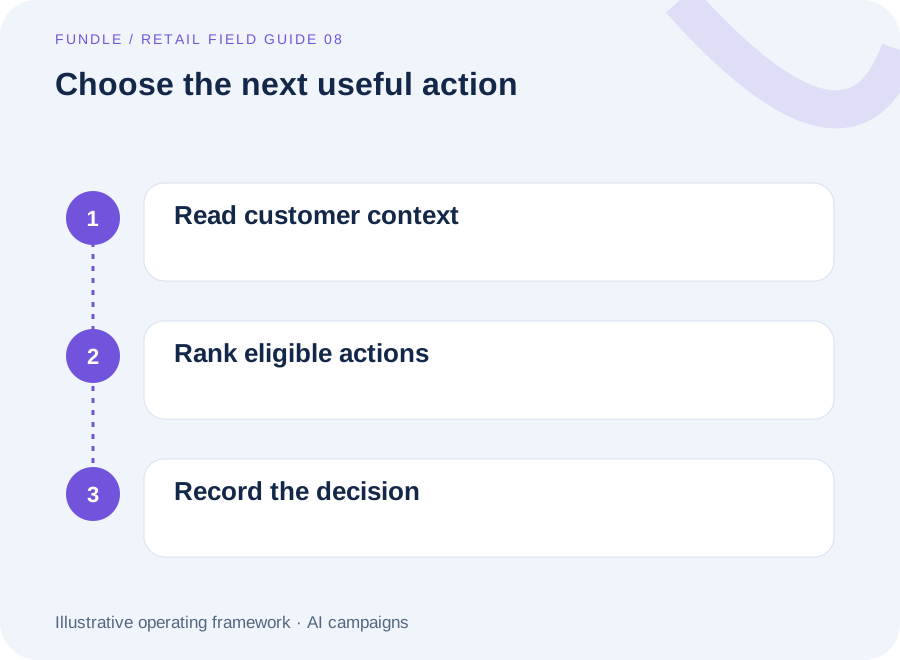
Define a small set of useful actions, including no promotional contact, and filter them through permission, service, stock and commercial constraints. Compare the remaining actions using a consistent objective and evidence available at decision time. Record the chosen action, rejected alternatives and outcome. Begin with reviewable rules, then test more adaptive decisioning only when feedback and evaluation are reliable.
Make the action concrete enough to evaluate
Next best action should describe a decision a retailer can actually execute. Examples include sending a replenishment reminder, offering a relevant benefit, inviting a customer to a fitting appointment, resolving a service issue or choosing no promotional contact. A vague recommendation to improve engagement cannot be assigned, costed or measured.
Define the action catalogue before asking an AI system to choose. Each action needs eligibility conditions, required data, an owner, a channel, an expected cost and a measurable outcome. Include the possibility that none of the promotional actions is appropriate. Otherwise the decision process will always find something to send, even when restraint would serve the relationship better.
Resolve constraints before comparing value
A pending complaint may make service resolution the priority. Missing stock can make a product offer unusable. A withdrawn channel permission removes that channel from consideration. These are decision boundaries that should be checked before any commercial ranking. A high expected purchase value should not override them.
Keep constraints close to the moment of action. A recommendation generated in the morning may be invalid by the afternoon if the customer has already purchased or the relevant size is unavailable. Record an expiry or refresh condition for the recommendation, and recheck material facts before dispatch. The original reasoning should remain visible even when the action is cancelled.
| Decision component | Required record | Example review question |
|---|---|---|
| Context | Verified events and current conditions | What changed for this customer? |
| Available actions | Eligible action catalogue | What can we actually fulfil? |
| Objective | Agreed value and cost definition | What outcome are we optimising? |
| Selection | Rule or model version and alternatives | Why this action rather than another? |
| Approval | Responsible owner and permitted scope | Who can authorise execution? |
| Feedback | Exposure, outcome and later corrections | Did the action improve the relationship? |
Use a common value basis for alternatives
Do not compare a reminder's predicted click rate with an offer's predicted revenue and call the larger number better. Alternatives need a common outcome, such as expected contribution over the same period, with customer-experience constraints alongside it. Include the cost of contact and any reward across the customers expected to use it.
Distinguish a forecast under an action from the action's incremental effect. A customer likely to purchase anyway can generate a large revenue forecast without needing intervention. Compare the expected outcome with the relevant existing experience. Where estimates are weak, present a range or a review request rather than manufacturing precision.
Use simple rules as a baseline. For example, a verified replenishment need with available stock might qualify for a reminder, while a recent complaint routes to service. An adaptive model should demonstrate improvement over that understandable baseline before the team gives it broader decision authority.
Worked hypothetical example: compare three eligible options
Assume there is no unresolved service issue and all applicable permissions are present. A retailer considers three actions for a customer. Under no additional promotional contact, the estimated purchase probability is 10%, and a purchase contributes ₹400 before any new campaign cost. Expected contribution is 0.10 multiplied by ₹400, or ₹40.
A reminder is estimated to produce a 14% purchase probability and costs ₹2 to send. Its expected contribution is 0.14 multiplied by ₹400, less ₹2, or ₹54. An offer is estimated to produce an 18% purchase probability, but every purchasing customer in that scenario uses a ₹100 reward. After the ₹2 contact cost, expected contribution is 0.18 multiplied by ₹300, less ₹2, or ₹52.
On these assumptions, the reminder has the highest expected contribution. Its estimated improvement over no additional contact is ₹14, compared with ₹12 for the offer. The offer has the highest purchase probability but is not the best commercial option on the selected value basis.
These probabilities are hypothetical planning inputs, not validated model outputs or Fundle results. If the customer has an unresolved complaint, the promotional comparison should be suspended in favour of the appropriate service process. If the estimates are uncertain, the team should test eligible alternatives rather than treating the ₹2 difference as established fact.
Learn from feedback without confusing selection with proof
Every decision creates selective feedback: the business observes what happened after the chosen action, not what the same customer would have done under every alternative. Vowpal Wabbit's contextual-bandit documentation explains this setting in terms of context, available actions and feedback for the selected action. Here, reward means a learning outcome, not necessarily loyalty points.
That distinction matters when reviewing historical campaign data. If an earlier team always sent discounts to the most inactive customers, their outcomes cannot be fairly compared with reminders sent to active customers. Preserve the selection process and use appropriately designed experiments when estimating the value of a new decision policy.
For adaptive methods, keep the action-selection probability where the chosen evaluation method requires it, along with the eligible action set and data snapshot. Do not add exploration to live customer journeys until the business has defined acceptable actions and evaluation controls. Advanced optimisation does not remove the need for a sensible customer proposition.
Set review boundaries and monitor drift
NIST's AI Risk Management Framework treats trustworthiness as a consideration throughout AI evaluation and use. Our retail recommendation is to separate suggestion, approval and execution. A manager should be able to inspect why an action was recommended and stop it when the underlying context is wrong.
Monitor changes in stock coverage, customer mix, response patterns and contact fatigue. A policy that looked useful during a festival may be inappropriate in a quieter period. Review missed opportunities and unnecessary contact, not only actions that produced purchases. Keep a route back to a known baseline when the evidence becomes unreliable.
Next-best-action evaluation checklist
- Define a limited action catalogue with a no-contact option.
- Apply permission, service and fulfilment constraints before scoring.
- Compare alternatives on the same outcome window and cost basis.
- Retain decision context, rejected choices and versioned reasoning.
- Test new policies against an understandable baseline.
- Refresh recommendations and review drift before widening execution scope.
Explore Fundle Brain and campaign management as a starting point for this decision workflow. Request a Fundle walkthrough with a real customer scenario and two plausible alternative actions. Confirm what evidence, approvals and feedback the proposed implementation can support before assigning execution responsibility.
Questions from retail teams
Is next best action the same as choosing the next best offer?
No. An offer is only one possible action. A useful decision may be a reminder, service intervention, appointment invitation or no promotional contact. Define the available actions around customer needs and operational capability. Restricting the catalogue to discounts encourages the system to solve every situation through price, even when another response would be more appropriate.
Why should no contact be an explicit option?
It provides a meaningful baseline and prevents the workflow from assuming that every customer needs a message. A recent purchase, high contact pressure or weak evidence may make no promotional contact the best choice. The business should still maintain any necessary service process. Record the reason for restraint so it can be reviewed alongside active recommendations.
Can a purchase prediction identify the best campaign action?
A purchase prediction alone describes likelihood under its modelling conditions; it does not compare the causal effects and costs of different actions. To choose among campaigns, the team needs consistent action-specific evidence or a carefully tested decision rule. Include the existing experience as a baseline and avoid equating a high forecast with a large incremental opportunity.
What does reward mean in a contextual-bandit approach?
It is the feedback signal the learning process seeks to improve, such as a defined commercial outcome or a measured cost. It does not necessarily mean a customer incentive or points award. Choose that signal carefully because optimising clicks, immediate purchases and longer-term contribution can lead to different actions and different customer experiences.
When should a next-best-action recommendation require human review?
Require review when the proposed action exceeds approved operating limits, depends on uncertain identity or data, changes a customer commitment or carries a material commercial cost. The exact boundaries should be agreed by the business. A clear review record should show context, alternatives and reasons, so approval is an informed decision rather than a routine confirmation click.
Sources and further reading
- Vowpal Wabbit: Contextual Bandits — Contextual decision setting, chosen-action-only feedback and action-selection probability in the documented learning representation. Retail recommendations and examples are original.
- NIST AI Risk Management Framework — Voluntary trustworthiness considerations during AI evaluation and use; suggested approval boundaries and drift checks are retail editorial guidance.