Marketplace catalogue and SKU mapping: build a dependable product crosswalk
How do you map marketplace catalogue listings to internal retail SKUs?
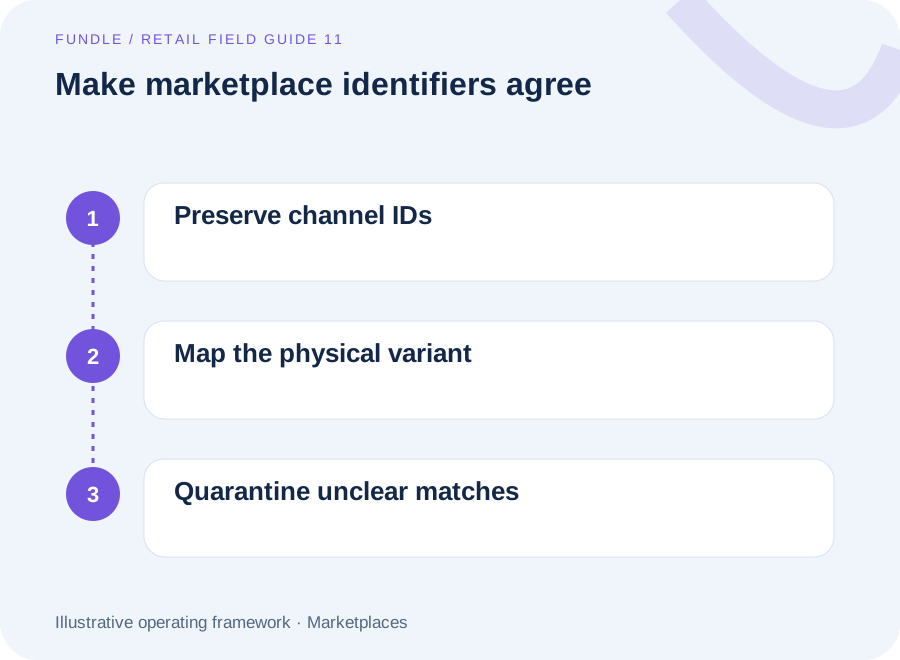
Create a governed crosswalk linking each marketplace account and listing identifier to an internal sellable variant, with GTIN where applicable, unit quantity and effective dates. Validate size, colour, pack and bundle composition before publishing the match. Quarantine ambiguous mappings, preserve historical versions and reconcile mapped quantities to source totals before using the data for decisions.
Treat the mapping as a business control
Two listings with similar titles can represent different sizes, colours, pack quantities or sellers. One internal variant can also appear under several channel-specific identifiers. Joining records by title alone creates plausible but misleading stock, returns and contribution reports. The first objective is correct identity, not the highest possible automatic match rate.
Define an internal sellable variant as the unit that your stock and commercial processes actually distinguish. Preserve a separate style or product-family identifier for analysis. A family-level relationship is useful for merchandising, but it should not replace the variant-level relationship needed to interpret a sale or return.
Separate identifiers and their roles
Your internal SKU identifies an item within your organisation. A marketplace listing identifier identifies a channel record. A GTIN identifies a trade item under the relevant identification standard. Keep these fields separate, including the marketplace and seller account that give channel identifiers their context.
GS1's variant guidance explains that size and colour variations require distinct identification. Google Merchant Center's GTIN guidance also warns against supplying invented identifiers. Use those principles to validate identity; neither source establishes that every marketplace or product category has identical listing requirements.
| Field | Why it belongs in the crosswalk |
|---|---|
| Account and channel identifier | Prevents a match leaking across seller accounts |
| Internal variant and style | Separates operational identity from grouping |
| Size, colour and pack quantity | Exposes physically different items |
| GTIN, when applicable | Adds an independently governed identifier |
| Effective dates and approver | Preserves historical meaning |
| Mapping status and evidence | Distinguishes verified matches from suggestions |
Design the review workflow around ambiguity
- Load source catalogue records without overwriting their original identifiers.
- Standardise formatting for comparison while retaining the original values.
- Suggest matches using validated identifiers and compatible variant attributes.
- Flag conflicts in quantity, size, colour, bundle components or identifier reuse.
- Have the catalogue owner approve the mapping and effective date.
- Test a small transaction sample before releasing the map into reporting.
A missing GTIN is not permission to create one. Record an absent identifier and follow the channel's applicable process. Similarly, a text similarity score is evidence for review, not proof that two products are interchangeable.
Give reviewers a side-by-side comparison showing the source title, images or approved master data, identifiers and unit definition. An exception should say what disagrees. A generic low-confidence label leaves reviewers repeating the same investigation.
Worked hypothetical example: packs change the unit count
An apparel brand has one approved single-unit sock SKU. Channel listing A is a three-pack of that exact variant; listing B is a single unit. During a period, A sells 40 packs and B sells 50 units. Correct consumption is 40 × 3 + 50 = 170 individual units.
If both listings are treated as single units, the report shows 90 units, understating consumption by 80. At an illustrative product cost of ₹100 per individual unit, that mistake understates product cost by ₹8,000. No change in customer behaviour caused the apparent improvement in contribution.
Now suppose another three-pack contains mixed colours. It cannot be mapped to three units of the original colour merely because the pack count agrees. Record the approved component composition. If the composition is unknown, keep the bundle unresolved rather than guessing a convenient conversion.
Preserve history when the catalogue changes
Do not reuse an old mapping to explain a changed pack. Create a new version with its effective period and the source change evidence. A transaction should resolve to the mapping valid for that event, not automatically to today's catalogue description.
Maintain a clear correction policy. A mistaken historical mapping may warrant reprocessing affected reports. A genuine product change should preserve earlier valid records. Document which reports were recalculated and notify their owners so revised numbers do not look like unexplained trading changes.
Use an impact preview before a bulk edit: affected listings, transactions, units, value and downstream views. This is especially important before joining returns or settlement events, where the wrong product identity can redirect an investigation to the wrong category manager.
Measure coverage without rewarding bad matches
Track verified mapping coverage by transaction value and units, not just catalogue row count. A large number of correctly matched inactive listings can conceal unmapped bestsellers. Show pending and disputed mappings separately, with the period and channel covered.
Sample approved mappings for accuracy. Monitor identifier reuse, sudden pack-factor changes and transactions outside a mapping's validity period. Report reconciliation totals before and after conversion so teams can explain why pack sales and individual-unit consumption differ.
A high match percentage is only useful if the matches are dependable. Keep uncertainty explicit and give high-value ambiguous records a review owner. This is safer than silently assigning them to a generic miscellaneous SKU that later becomes invisible in management reports.
Practical release checklist
Confirm account scope, variant attributes, pack quantity, bundle components, effective dates and reviewer approval. Verify that quantities reconcile using the documented conversion, and that returns refer back to the appropriate sold configuration. Check that one source listing does not resolve to conflicting active variants.
Finally, test how an unmapped record appears to a manager. It should remain discoverable, with an understandable reason and a route to correction. Missing identity must not masquerade as zero demand or zero cost.
Evaluate a product-data walkthrough
Bring a single unit, a multipack, a mixed bundle and an ambiguous listing to a marketplace workflow discussion. Ask how a proposed Fundle Brain decision view would preserve identity and expose unresolved mappings. Validate the data contract before discussing automation; no marketplace connection or matching capability should be assumed from a product label.
Questions from retail teams
Can we use product titles as the main matching key?
Titles are useful supporting evidence but are unreliable primary keys. Sellers can change wording, abbreviate sizes or use similar names for different packs. Prefer approved identifiers combined with variant and unit checks. When only text is available, treat the match as a review candidate and retain the evidence and person who approved it.
How should bundles be represented?
Record the bundle as a sellable item with an explicit component list and quantities when component-level analysis is required. Distinguish fixed bundles from configurations that can vary. Validate how returns and replacements affect the components. A pack factor alone is insufficient when a bundle contains different colours, sizes or product types.
What is the difference between a SKU and a GTIN?
A SKU is an organisation's internal product identifier, while a GTIN follows a standard for identifying trade items. They can both appear in a product record but should not be treated as interchangeable strings. Preserve the original values, validate their intended level and avoid manufacturing a GTIN from an internal SKU.
Should we overwrite historical mappings when a listing changes?
Usually you should preserve the old version and add an effective-dated change. Historical transactions need the product meaning that applied when they occurred. If the old mapping was an error, correct it through a documented reprocessing process. Separate a genuine product change from an administrative correction so downstream reports remain explainable.
How do we prioritise thousands of unmapped listings?
Rank them by recent transaction value, unit volume, returns exposure and operational urgency. Add a separate queue for identifier conflicts that could contaminate already mapped records. Review inactive long-tail listings later. Track verified coverage on actual business activity, because a high percentage of mapped catalogue rows can still leave important sales unresolved.
Sources and further reading
- GS1: GTINs for sizes and colours — GS1 guidance on unique identification of product variants.
- Google Merchant Center: GTIN — Official product identifier guidance, including matching identifiers to variants and not inventing GTINs.