Marketplace SKU contribution: what remains after fees, returns and advertising?
How do you calculate marketplace SKU contribution after fees, returns and advertising?
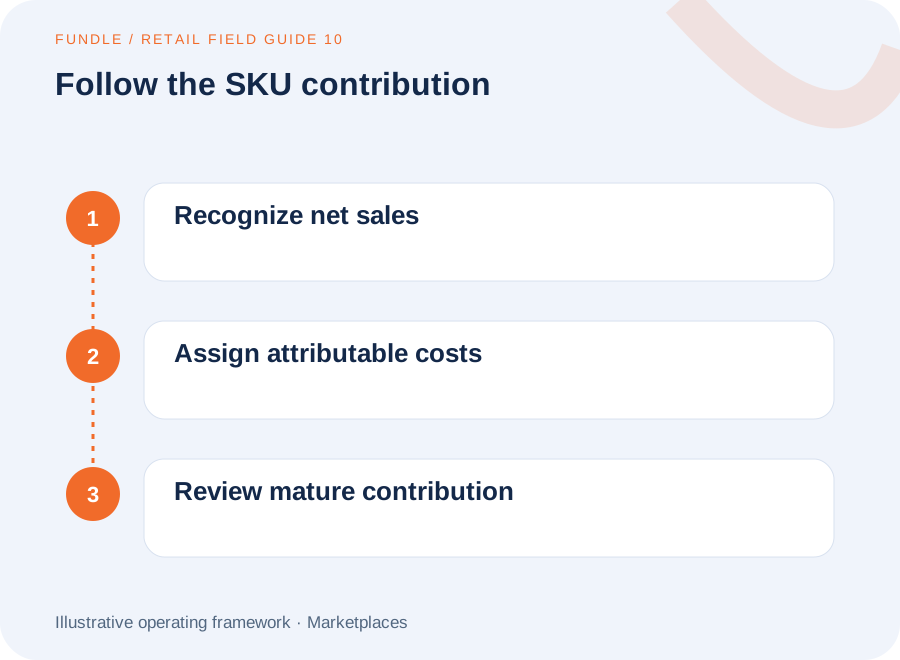
Calculate SKU contribution from net realised sales on a defined basis, then subtract the product cost of retained units and attributable marketplace, fulfilment, return and advertising costs. Reconcile refunds and recovered stock separately to avoid double counting. Show the period, return maturity and allocation method so a profitable-looking SKU is not supported by incomplete costs.
Define the decision before the margin
A SKU contribution report should help a category manager decide whether to change price, promotion, advertising, fulfilment or assortment. A single percentage labelled profit rarely does that. Specify which costs are included, which are allocated and which remain outside the view. Contribution before fixed overhead is useful, but it is not the same as company net profit.
Start at the sellable variant and marketplace account. A parent style can hide a weak size, costly bundle or fulfilment route. Preserve both unit economics and total contribution: a healthy percentage on very few units may matter less than a modest improvement on an established product.
Use a consistent commercial basis
Define sales after customer discounts and refunds, with the treatment of taxes stated by finance. Record platform-funded promotions separately from brand-funded discounts when the evidence supports that distinction. Do not subtract a discount again if it is already reflected in the realised selling value.
Amazon India's official fee overview demonstrates that selling costs contain multiple components. Use actual transaction costs where possible and identify estimates when fees have not yet posted. The analysis here does not assume any marketplace has a particular rate or that Fundle has an integration with it.
| Layer | Recommended treatment | Common error |
|---|---|---|
| Net realised sales | Consistent basis after refunds | Using catalogue price |
| Product cost | Retained units plus unrecovered loss | Expensing resellable returns twice |
| Channel and fulfilment | Actual fees and logistics where available | Counting only commission |
| Return handling | Reverse freight, inspection, damage | Treating all returns identically |
| Advertising | Disclosed attribution or allocation rule | Hiding unallocated spend |
Match revenue and cost to the same population
Maintain an order cohort view alongside a calendar-period view. The cohort view follows orders placed or delivered in a chosen period through later refunds and adjustments. The calendar view explains what was posted during the month. Neither is inherently superior; they answer different questions.
Shopify's finance reporting documentation illustrates that sales and payment timing can differ. For contribution analysis, the practical consequence is to avoid matching this month's sales with whatever cash happened to arrive this month.
Set a maturity rule appropriate to the product's return behaviour and observed reporting lag. Recent cohorts should carry a provisional label and a stated return-cost assumption. Recalculate mature cohorts, keeping prior versions so managers can see how estimates changed.
Worked hypothetical example: attractive sales, modest contribution
Suppose 100 units sell for ₹1,000 each on an agreed ex-tax basis. Ten are fully refunded, leaving net realised sales of ₹90,000. Product cost is ₹400 per unit; all ten returned units are inspected and fully resellable, so the retained-unit product cost is 90 × ₹400 = ₹36,000.
Assume actual marketplace fees of ₹12,000, fulfilment costs of ₹6,000, return handling of ₹1,500 and attributable advertising of ₹15,000. Contribution is ₹90,000 − ₹36,000 − ₹12,000 − ₹6,000 − ₹1,500 − ₹15,000 = ₹19,500.
That is ₹195 per originally sold unit or about ₹216.67 per retained unit. Contribution divided by net realised sales is 21.67%. State which unit denominator appears on the dashboard. These are hypothetical costs, not published platform rates or a customer result.
If two returned units instead become unsellable with no recovery value, add ₹800 of product loss. Contribution falls to ₹18,700. Inventory condition has changed the economics even though the refund total is unchanged.
Allocate advertising without pretending it is exact
Separate directly attributed advertising from shared brand or category spend. Record attribution window and the report used. Advertising-attributed sales do not automatically equal incremental sales; customers may have bought without the ad, and attribution systems may credit overlapping journeys.
A transparent management view can show contribution before ads, after directly attributed ads and after a disclosed share of shared spend. Reconcile the allocation total to the advertising bill. Keep unmatched spend visible rather than redistributing it silently until every SKU appears precise.
Use experiments where feasible to test whether a budget change improves total contribution. Avoid pausing a product solely because a short window contains expense before its sales or return effects have matured.
Translate diagnosis into a controlled action
Low contribution can have different causes. High reverse freight may call for packaging or product-description review. Excessive ad expense may call for query or placement changes. A poor size curve may call for stock redistribution. Low realised price may require examining discounts and promotion funding.
Choose one intervention with an owner, a review date and guardrails for stock, service and contribution. Compare equivalent periods or suitable cohorts, while acknowledging seasonality and competition. Record whether the action improved the business outcome rather than merely reducing a visible cost.
Practical SKU review checklist
Confirm variant mapping, cost-effective dates, refund coverage, return condition, fee completeness and advertising allocation. Show unmapped transactions and provisional costs next to the result. Reconcile totals to channel statements and inspect the largest negative-contribution items individually.
Then challenge the recommendation: is there enough stock to support more advertising, could a price change affect conversion, and are lower sales caused by availability? A margin table cannot answer those questions without the associated operational evidence.
Make the walkthrough commercially specific
Use marketplace intelligence and Fundle Brain as the context for a workflow discussion. Bring one profitable SKU, one apparent loss-maker and one ambiguous example. Ask for an inspectable bridge from orders to contribution, with allocations and uncertainty exposed, before deciding whether any proposed implementation meets your operating needs.
Questions from retail teams
Is contribution margin the same as gross margin?
Not necessarily. Gross margin commonly compares revenue with product cost, while a channel contribution view can also deduct variable fulfilment, marketplace, return and advertising costs. Agree the cost boundary with finance and display it clearly. Comparing figures with different boundaries can make one channel appear unfairly better or worse.
How should resellable returned inventory affect the calculation?
Separate the customer refund from the physical stock outcome. A fully resellable return may restore inventory value, while reverse freight and inspection still cost money. A damaged return may create an additional product loss. Use your finance-approved costing policy, and avoid treating every returned unit as both permanently consumed and fully recovered.
Which denominator should we use for contribution per unit?
Choose the denominator that matches the decision and label it. Contribution per shipped unit captures failed deliveries and returns within the original workload. Contribution per retained unit describes the economics of units customers kept. Show both when return rates vary materially; otherwise a change in denominator can disguise deteriorating operations.
Can a positive return on ad spend still mean a losing SKU?
Yes. Advertising return measures attributed sales relative to advertising expense, not all costs of serving those sales. Product cost, fees, fulfilment, discounts and returns can consume the remaining value. Review contribution after those costs and distinguish attributed revenue from demonstrated incremental revenue before treating a strong advertising ratio as commercial success.
What if marketplace costs arrive after the monthly review?
Show provisional contribution with separately identified estimates and their source. Reconcile those estimates to actual postings when they arrive, then explain the revision. Keep the original cohort intact so late costs do not disappear into an unrelated month. Managers should know whether a recommendation rests on mature evidence or incomplete cost recognition.
Sources and further reading
- Amazon India: Fees and Pricing — Documented fee categories and category/price/fulfilment dependence; hypothetical amounts are not platform rates.
- Shopify: Finance reports — Documented distinction between sales and payment reports and their timing.