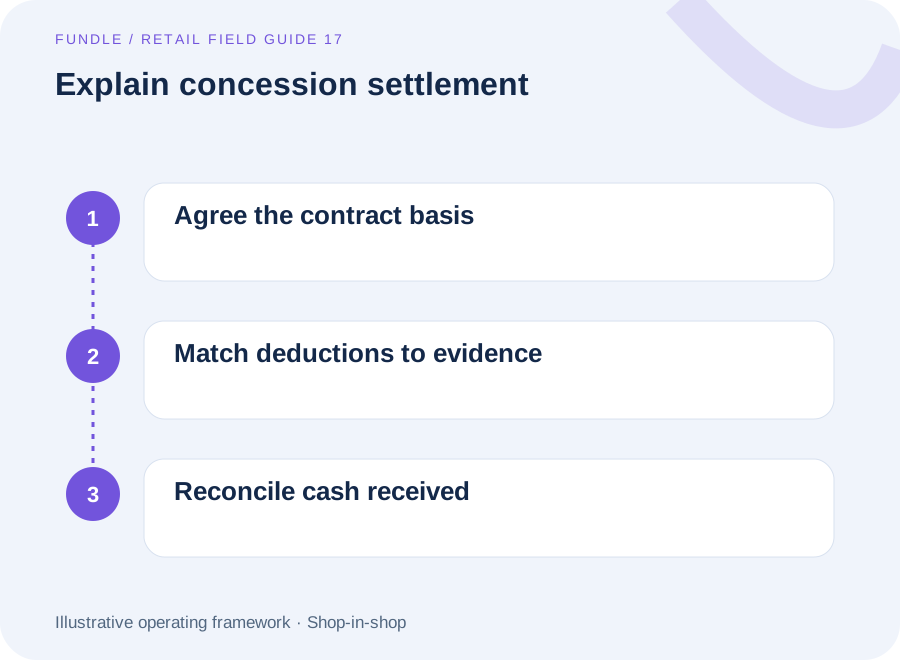
SIS concession settlement reconciliation: connect store sales to the amount received
How should brands reconcile shop-in-shop concession settlements?
Reconcile a concession settlement by connecting the host's eligible sales and returns to the applicable commercial agreement, authorised charges, previous adjustments and bank receipt. Keep stock ownership, sales recognition and payout timing distinct. Explain every difference, preserve contract versions and assign unresolved items to an owner instead of treating the host's net statement as self-explanatory.
Start from the agreement, not an assumed commission
Shop-in-shop agreements can define different commercial bases, charges, timing and responsibilities. A percentage deduction on a statement is not enough to reconstruct what the brand should receive. Read the approved terms and identify the eligible sales basis, treatment of returns, discount funding, fixed charges, adjustments and settlement period.
Document whether the arrangement is an outright purchase, consignment or another concession model. Avoid using the same settlement formula across contracts merely because the locations share a channel label. Ownership and payment obligations require the actual agreement and finance interpretation.
The operational goal is an evidence bridge from consumer activity to host statement to bank receipt. Accounting recognition, tax treatment and contractual interpretation remain matters for the relevant finance and commercial owners.
Maintain separate sales, stock and cash records
The host's POS records explain consumer transactions. Stock records explain receipts, transfers, returns and ownership-related events. Settlement records explain charges and payable amounts, while bank records confirm money received. Connect them with references without collapsing their distinct meanings.
Oracle's consignment lifecycle documentation illustrates a workflow that links consumption evidence and supplier settlement. It is a reference model, not evidence that a particular SIS host uses Oracle or that every concession settles on the same event.
Shopify's finance reporting guidance separately illustrates that sales and payments can fall in different periods. Preserve both dates when explaining a concession's trading performance and cash position.
Build the reconciliation at the right grain
Use host account, concession location, transaction line, variant and commercial period. Retain statement identifiers and line references for charges that are not tied to a specific sale. Store the agreement version that governs each calculation.
| Reconciliation layer | Required question |
|---|---|
| Eligible consumer sales | Which locations, dates and lines qualify? |
| Returns and discounts | Which reversals and funding rules apply? |
| Variable concession charges | What basis and rate were authorised? |
| Fixed charges and adjustments | What evidence supports each amount? |
| Prior balances and credits | What remains from earlier periods? |
| Payout and bank receipt | What was instructed and what arrived? |
Reconcile host-reported totals to transaction detail before evaluating charges. A mathematically correct fee applied to incomplete sales is still an incomplete settlement view. Show missing locations or periods explicitly rather than allowing them to disappear inside a net total.
Worked hypothetical example: investigate the residual
Assume an illustrative agreement charges 20% of eligible net sales, plus a fixed ₹10,000 service charge for the period. All figures are on one agreed ex-tax basis. There are no opening balances, withholding items or other deductions in this simplified example.
Eligible gross sales are ₹5,00,000 and qualifying returns are ₹40,000. Net sales are ₹4,60,000. The percentage charge is 20% × ₹4,60,000 = ₹92,000. Add an approved prior-period credit of ₹5,000.
Expected payment is ₹4,60,000 − ₹92,000 − ₹10,000 + ₹5,000 = ₹3,63,000. The bank receives ₹3,55,000, leaving ₹8,000 unexplained. That residual requires investigation; it is not automatically an unauthorised charge or a recoverable amount.
If evidence establishes a valid ₹8,000 adjustment under the agreement, the bridge reconciles. If only ₹3,000 is supported, record that partial resolution and retain a ₹5,000 open balance. Do not overwrite the original statement to make the difference disappear.
Test the commercial rules that cause disputes
Confirm whether the charge applies before or after customer discounts and returns. Identify who funds host promotions and how that funding appears in the statement. Determine how later returns affect an earlier settlement and whether credits appear in the next period.
Where an agreement contains a minimum guarantee or a higher-of calculation, model that rule explicitly. Do not assume the fixed and percentage amounts are always additive. Check the measurement period and approved treatment of partial opening months, closures or changed space.
Keep approved term changes effective-dated. A current rate should not automatically recalculate older transactions. When a correction is needed, preserve the prior result, amended evidence and scope of reprocessing.
Classify differences before assigning recovery work
Useful categories include missing sales, unmatched returns, rate disagreement, unsupported fixed charge, duplicate adjustment, absent credit and payment timing. Give each category an evidence checklist and an accountable owner. Store the partner's stated reason separately from the brand's investigation outcome.
Key account management may resolve commercial interpretation, while store operations verifies transaction or stock evidence and finance confirms the payment bridge. One case owner should coordinate the work so a difference does not circulate between departments without a next action.
Track disputed value, supported adjustments, approved credits and cash received separately. A settled commercial disagreement can close without producing new cash, and a credit awaiting payment should remain visible.
Practical settlement-close checklist
Confirm complete concession coverage, the correct contract version and a reproducible sales-to-statement bridge. Review return cutoffs, promotion funding, fixed charges, prior credits and bank references. Reconcile currencies independently where relevant and retain the finance-approved treatment of taxes and other statutory items outside the simplified management example.
Sample one straightforward settlement and one partial exception. Ask a reviewer to reproduce both from source records. Carry unresolved balances into the next period with their original references, age and responsible owner.
Evaluate an evidence-led walkthrough
Bring a redacted host statement, relevant agreement schedule and bank receipt to a partner-retail workflow walkthrough. Ask how Fundle Brain could present the calculation, supporting records and unresolved differences. Confirm the proposed workflow and source access explicitly; this guide does not claim an existing relationship with any named concession host or an automated settlement connection.
Questions from retail teams
Should every SIS settlement use sales minus commission?
No. The agreement may include different eligible-sales definitions, fixed charges, minimum guarantees, promotion funding or other adjustments. Establish the actual commercial model and approved calculation before comparing statements. A simplified commission formula is useful only when it accurately reflects that concession's terms and the period being reviewed.
How do we treat a customer return from an earlier month?
Link it to the original transaction and apply the agreement's return and settlement rules. Preserve both the original sale period and the date of the reversal or credit. This allows the team to explain period trading and current cash separately, while avoiding a second deduction when the same return appears in another export.
What if the statement total matches the bank but still seems wrong?
That proves the stated payout reached the bank, not that the underlying commercial calculation was correct. Reconcile eligible sales, returns, rates, charges and credits to source evidence and contract terms. Bank matching is the final cash check; it cannot replace validation of what the host should have paid.
How should minimum guarantees be handled?
Model the approved rule and its period explicitly, including whether it replaces, exceeds or combines with other charges. Check how closures, partial months and amendments are treated. Do not infer the formula from a statement label. Have the commercial and finance owners resolve ambiguity before using the calculation to approve or dispute a settlement.
When is an unresolved deduction a recoverable amount?
Only after evidence supports the brand's entitlement and the relevant resolution process establishes what can be recovered. Initially it is an unexplained or disputed difference. Keep claim submission, approval, credit issuance and cash receipt as separate stages. This prevents the exception dashboard from overstating both leakage and realised recovery.
Sources and further reading
- Oracle: Consigned Inventory Lifecycle — Documented separation of physical possession, ownership, consumption advice and invoice matching in a consignment workflow.
- Shopify: Finance reports — Documented distinction between sales and payment reports and their timing.