How malls should measure repeat visits from loyalty programmes
How should a mall measure repeat visits from its loyalty programme?
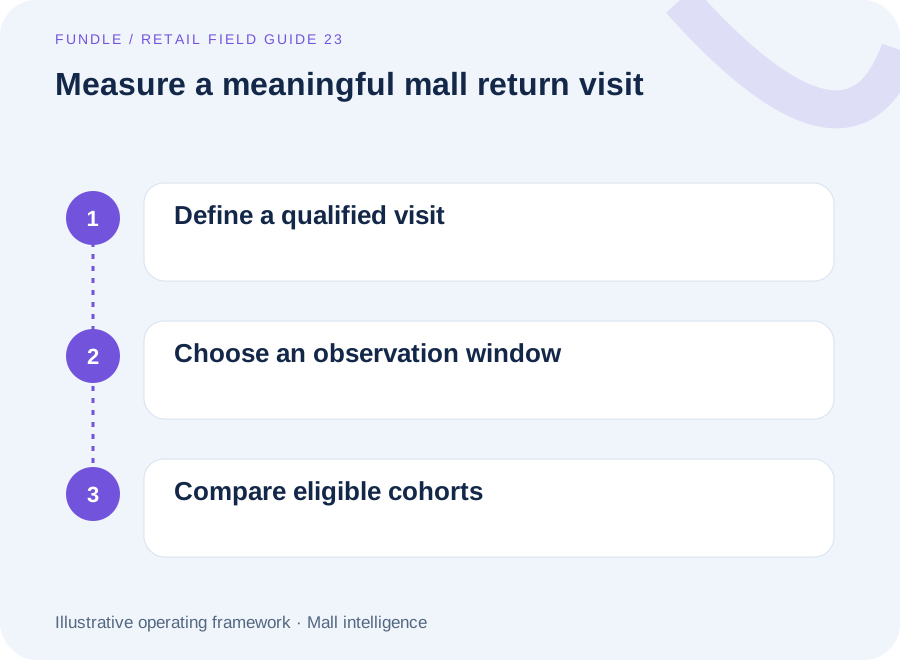
Define a qualifying visit, identify a mature visitor cohort and measure the share returning within the same observation window. Deduplicate bills from the same visit and show participating-tenant coverage. Keep member repeat behaviour separate from total mall footfall and from causal programme impact. Use a suitable comparison to evaluate whether rewards created additional visits rather than merely recording existing shoppers.
Decide what counts as a visit
A loyalty programme often sees uploaded bills, event registrations or redemption records. None is automatically equivalent to a unique mall visit. One shopper may upload several bills from the same afternoon. Another may visit without transacting at a participating tenant. A third may upload yesterday’s bill today. Start by naming the behaviour the available evidence can actually observe.
A useful first measure may be a validated shopping day for an identified programme member. Define it as one member with at least one eligible validated bill dated within a local calendar day at the property. That is an editorial measurement option, not a universal standard. If entry or parking data is used, its counting and matching limitations require separate treatment.
Build cohorts with equal opportunity to return
Choose the cohort entry event: first validated programme shopping day, enrolment or first redemption. Each answers a different question. For a repeat-shopping measure, the first validated shopping day is often clearer than enrolment because registration alone does not demonstrate a visit.
Shopify’s customer cohort documentation illustrates grouping customers by first purchase and observing later periods. For malls, adapt that cohort discipline to the chosen visit evidence. Do not claim that an online-store cohort report measures mall entry or that purchase retention automatically describes all visitors.
A 30-day return measure needs members whose first qualifying day occurred at least 30 days before the reporting cut-off. Show newer members separately until their window matures. Otherwise, a busy acquisition month can make retention appear to decline simply because many recruits have not had time to return.
Use a clear measurement dictionary
| Measure | Recommended definition for the stated scope | Important limitation |
|---|---|---|
| Observed repeat-shopping rate | Mature cohort members with another qualifying day divided by mature cohort members | Describes identifiable programme activity |
| Time to next shopping day | Days from cohort entry to first subsequent qualifying day | Non-returners need explicit treatment |
| Cross-tenant participation | Members buying at multiple participating tenants within the chosen window | Depends on tenant and bill coverage |
| Reward participation | Eligible members redeeming under defined rules divided by eligible members | Redemption alone is not incremental behaviour |
| Validated bill coverage | Accepted eligible bills relative to the source population that can be assessed | Unsubmitted visitor purchases may remain unknown |
| Programme economics | Relevant contribution or agreed value proxy less programme cost | Mall and tenant value are different viewpoints |
Do not mix every metric into one loyalty score. A rise in cross-tenant shopping and a fall in repeat days may reflect different behaviours that require different actions.
A worked hypothetical cohort
Assume a mall has 1,000 identified members whose first qualifying shopping day has a complete 30-day observation window. Three hundred record at least one later qualifying day in that window. The observed repeat-shopping rate is 300 ÷ 1,000 = 30%.
Another 200 members joined too recently to complete the same window. Adding them to the denominator would produce 300 ÷ 1,200 = 25%, an apparently weaker result created by unequal observation time. Keep those 200 in an immature cohort until the agreed cut-off is reached.
Suppose the 300 returning members upload 720 validated bills during their later shopping days. Those 720 bills are not 720 returning people and need not represent 720 visits. Retain member, bill, tenant, bill date and upload date separately so the report can deduplicate the intended unit correctly. These figures are hypothetical and contain no customer evidence.
Test bill quality before interpreting loyalty
Require the fields needed for the programme rule, such as tenant identifier, transaction date, bill reference and eligible value. Check duplicates across uploads and accounts using the approved operating process. Preserve rejection reasons and correction history. A rejected upload is neither proof of fraud nor a validated shopping event.
Separate the transaction date from the upload and approval dates. A campaign may cause faster uploading without changing actual visit frequency. If the programme’s measurement uses upload time as a visit date, that process change can appear as customer behaviour. Use the evidence date appropriate to the question and make late submissions visible.
Show the limits of the observed population
Members who enrol in rewards may already be more frequent shoppers. Participating tenants may differ from the wider mall in category, ticket size and reporting reliability. A programme report therefore should not be presented as a census of all mall visitors.
Show active tenant coverage, bill acceptance and known gaps alongside the cohort result. Explain tenant launches, closures and changes in eligibility. A new food-and-beverage partner can increase observed shopping days even if underlying mall visitation is unchanged. Stable comparison sets help distinguish coverage expansion from behaviour change.
Separate programme association from programme impact
A high member return rate can be useful operational evidence without proving that rewards caused the visits. To evaluate impact, define a suitable comparison around an eligible intervention, such as a particular invitation or benefit. Avoid withholding a promised existing entitlement simply to manufacture a control.
Google’s Conversion Lift explanation provides the general measurement distinction between observed credited outcomes and additional outcomes estimated through a held-back comparison. Applying that principle to a mall programme requires a separate design suited to visitor identity, exposure and practical operations; it is not an assertion that Google’s product measures offline mall loyalty directly.
Track the value perspective clearly. Tenant sales, mall income, campaign delivery and programme costs are not interchangeable. If direct contribution cannot be established, report an agreed operating proxy and its limitation instead of inventing an ROI figure.
Practical monthly review checklist
- Confirm the qualifying event and deduplication unit.
- Freeze the cohort entry rule and mature observation window.
- Separate bill dates, uploads, approvals and reversals.
- Review tenant coverage and unresolved validation exceptions.
- Compare equivalent cohorts and explain programme-rule changes.
- Distinguish member association from tested intervention impact.
- Assign a next action to a specific visitor or tenant question.
Explore mall loyalty alongside mall intelligence. Request a Fundle workflow walkthrough using multiple same-day bills, a late upload and an immature cohort. Ask how the proposed reporting view preserves these distinctions and what evidence is available before relying on repeat-visit claims.
Questions from retail teams
Can every bill upload be counted as a mall visit?
No. Several bills may come from the same shopping day, and upload time may differ from the transaction date. Define the visit proxy your evidence supports and deduplicate accordingly. Retain bill, member, tenant and date references so the team can explain the difference between uploaded receipts, shopping days and identified visitors.
Why should recently enrolled members be excluded from a 30-day return rate?
They should remain visible in a separate immature cohort until they have had the full opportunity to return within the defined window. Including them too early changes the denominator unfairly. Once their window matures, calculate the same outcome using the same event definition and reporting cut-off rules.
Does strong member retention prove that mall loyalty works?
It shows observed behaviour among the members represented by the data, but enrolled shoppers may already be more engaged. To assess the effect of a specific benefit or invitation, use an appropriate comparison design. Keep the descriptive retention result separate from claims about additional visits caused by the programme.
How do tenant additions affect the reported repeat rate?
New participating tenants can make more existing shopping activity visible. That can raise measured repeat days without changing total visitation. Show coverage changes and compare stable tenant sets where useful. Keep a full programme view as well, so the business can see both observed growth and the limits of like-for-like comparisons.
What should a mall do when it cannot link entry counts to loyalty members?
Maintain separate reports with clearly labelled populations. Entry counts can describe traffic under the counter’s rules; validated member activity can describe identified programme behaviour. Do not assume one is a subset with a known conversion rate unless the matching and coverage support that calculation. Improve the data contract before combining the measures.
Sources and further reading
- Shopify customer cohort reporting — Documents first-purchase cohorts and subsequent period analysis. Mall visit-cohort adaptation and definitions are original guidance.
- Google Ads understanding Conversion Lift — Supports the descriptive-attribution versus incremental-outcome distinction, not a specific mall measurement capability.