Mall tenant data quality: the foundation of a credible trading brief
How should a mall improve tenant data quality before analysing sales?
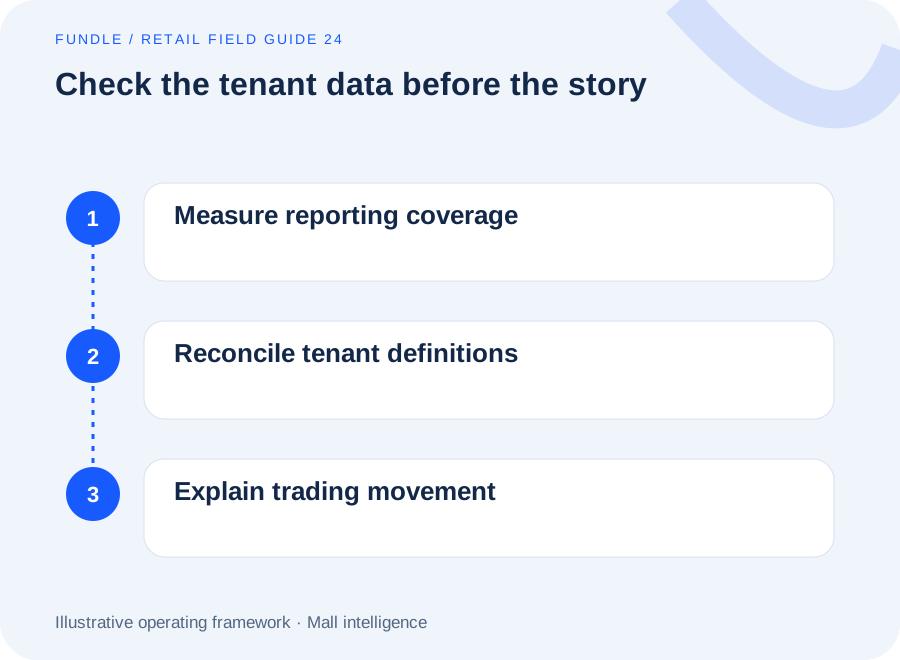
Start with an effective-dated tenant master, a clear reporting calendar and explicit states for missing, rejected, corrected and validated submissions. Preserve source files and sales definitions, then compare equivalent tenants and periods. Show reporting coverage beside commercial movement. A clean-looking total is not dependable trading intelligence when absent tenants, duplicate files or changed definitions remain hidden.
The first question is whether the comparison exists
A mall can receive an impressive-looking sales total before the underlying tenant population is complete. The operational risk is immediate: leasing or marketing teams may act on a supposed category decline that is actually a late submission. Before asking why sales moved, ask which tenants, dates and definitions are represented in both sides of the comparison.
Treat data quality as part of the daily trading process. A separate monthly technical report is too late for a morning decision. Put missing submissions, validation exceptions and correction status beside the commercial view so the meeting can route each issue to the right owner.
Build a tenant master that survives change
Use a stable tenant identifier and separate it from trading name, legal entity, unit, category and reporting contact. Record effective dates for openings, closures, relocations and category changes. Decide how a tenant operating multiple units or counters is represented. Otherwise, the same business may appear twice or disappear when a display name changes.
The GS1 explanation of Global Location Numbers describes identifiers for parties and locations. A mall does not need to adopt a particular external identifier merely to begin reporting, but the distinction is useful: the business party and the physical unit are not necessarily the same object. Preserve whichever stable identifiers the agreed operating model uses.
Keep the expected-report calendar linked to active trading dates. A closed unit should not generate the same missing-report alert as an open store. A scheduled closure and a confirmed zero-sales trading day should remain different states.
Define quality in relation to the decision
The UK Government Data Quality Framework guidance recommends identifying critical data, setting fit-for-purpose rules, measuring quality and recording improvement actions. Applied to mall reporting, the editorial recommendation is to prioritise defects that would change the trading conclusion, rather than treating every blank field as equally important.
| Quality check | Tenant-reporting example | Operating response |
|---|---|---|
| Completeness | An expected tenant-day has no submission | Follow up with the reporting owner |
| Uniqueness | Two files represent the same tenant and day | Identify the valid version without adding both |
| Consistency | Category or sales definition changes between periods | Resolve the definition before comparison |
| Timeliness | A report arrives after the morning cut-off | Mark the view provisional and update transparently |
| Validity | Date or currency format violates the source contract | Quarantine the affected row for correction |
| Accuracy | A plausible value does not match the source statement | Verify evidence with the tenant contact |
A value can pass a format check and still be inaccurate. An unusual sales amount can be genuine. Use flags to request investigation, not as permission for an AI system or analyst to silently replace a financial figure.
Preserve four reporting states
No file means the expected evidence is absent. A rejected file means evidence arrived but failed the agreed checks. A validated zero means the tenant supplied a confirmed value of zero under the reporting definition. A corrected submission means an earlier record has been replaced through a traceable decision.
These states should drive different queues. Missing and rejected submissions need source follow-up. Corrected records need controlled downstream updates. A zero-sales day may need a commercial explanation, but it should not be automatically filled with an estimate because the total looks low.
Retain the original file, receipt time, reporting period, source-row reference, rule version and reviewer decision. Define how a later correction changes the current view while preserving what was known at the earlier meeting.
A worked hypothetical morning brief
Assume 50 active tenants are expected to report for yesterday. Forty submissions arrive, two fail validation and 38 are accepted. Received coverage is 40 ÷ 50 = 80%, while validated coverage is 38 ÷ 50 = 76%. There are ten missing submissions and two validation exceptions. Both queues matter, and neither should be recorded as zero sales.
The 38 accepted tenants report ₹1.50 crore. A prior-period network total of ₹1.60 crore covered all 50 tenants. Comparing those totals produces an apparent decline of 6.25%, but the populations are inconsistent and the figure should not be presented as comparable trading movement.
Suppose 30 tenants have complete, equivalent records in both periods. They report ₹1.26 crore now against ₹1.20 crore previously. Comparable movement for that specific set is (1.26 − 1.20) ÷ 1.20 = 5%. This does not establish growth for the entire property. The management brief should show the positive comparable result, the incomplete wider coverage and the outstanding owners together.
All values are hypothetical. The example deliberately distinguishes a data-collection measure from a commercial performance measure; combining them would produce the wrong operating discussion.
Align sales and area definitions
Confirm the sales basis, treatment of returns, reporting currency and period cut-off. If a trading-density measure uses area, define the area field and its effective date. Do not compare a sales numerator covering one tenant set with an area denominator covering another. Relocations and partial closures require explicit handling.
Keep portfolio comparisons equally disciplined. Property totals may reflect different tenant mixes, opening dates and collection coverage. A common category label is helpful, but it does not remove local context. Present the comparable subset and explain exclusions before interpreting rankings.
Turn exceptions into a useful operating queue
Assign the tenant contact, mall owner, issue type, due time and evidence required to close the item. Track repeat format failures separately from occasional late submissions. A recurring mapping problem needs a source-contract fix; repeatedly chasing the same file without changing the process wastes both teams’ time.
Review corrections that materially alter earlier conclusions. The aim is not to punish a late update but to understand whether the daily decision process needs a later cut-off, better validation or a clearer provisional label. Preserve a short explanation with the amended brief.
Daily quality checklist
- Freeze the active tenant list and expected reporting dates.
- Separate missing, rejected, corrected and validated states.
- Check duplicates, source references and definition changes.
- Show validated coverage beside the sales total.
- Select the comparable tenant and period set explicitly.
- Verify area and category context where used.
- End the meeting with owners for the data gaps and the trading questions.
Explore ADSR collection and validation together with mall intelligence. Request a Fundle workflow walkthrough using a late report, a duplicate file and a corrected tenant value. Ask how the proposed interface keeps completeness and movement separate and which operating controls are available in the deployment.
Questions from retail teams
Should missing tenant sales be filled with zero?
No. A missing report means the value is unknown under the current collection process. A zero-sales day is a confirmed reported state with its own evidence. Keeping them separate prevents an absent file from being misread as a trading collapse and preserves the correct owner for the next follow-up.
What is the difference between received coverage and validated coverage?
Received coverage counts expected submissions that arrived. Validated coverage counts those that also passed the agreed checks. A rejected file improves the first measure but not the second. Show both with the same expected-report denominator so management can distinguish a collection delay from a source-quality problem.
Can comparable sales be reported when some tenants are missing?
Yes, for an explicitly defined subset with suitable records in both periods. Label the tenant coverage and exclusions, and keep the incomplete network total separate. Do not imply that the subset establishes the property’s complete movement, especially when missing tenants are concentrated in a large category or a major anchor.
How should a corrected tenant submission affect yesterday’s brief?
Update the current reporting view through a controlled version process while preserving the original submission and the earlier conclusion. Record who approved the correction and why. If the change alters a material management interpretation, communicate the amendment with enough context for the commercial team to revisit the relevant action.
Can AI decide that an unusual tenant value is wrong?
It can be evaluated for flagging an unusual record or explaining why review is needed, but a statistical outlier is not proof of error. Keep the source evidence and agreed validation rules. Financial corrections should follow the authorised review process, with the original value and the reason for any change retained.
Sources and further reading
- GS1 explanation of Global Location Numbers — Primary definition of identifiers for parties and locations. The mall master design is an original recommendation, not a mandatory GS1 implementation claim.
- UK Government Data Quality Framework guidance — Fit-for-purpose quality rules, measurement and improvement ownership. Tenant-specific checks and arithmetic are original recommendations.