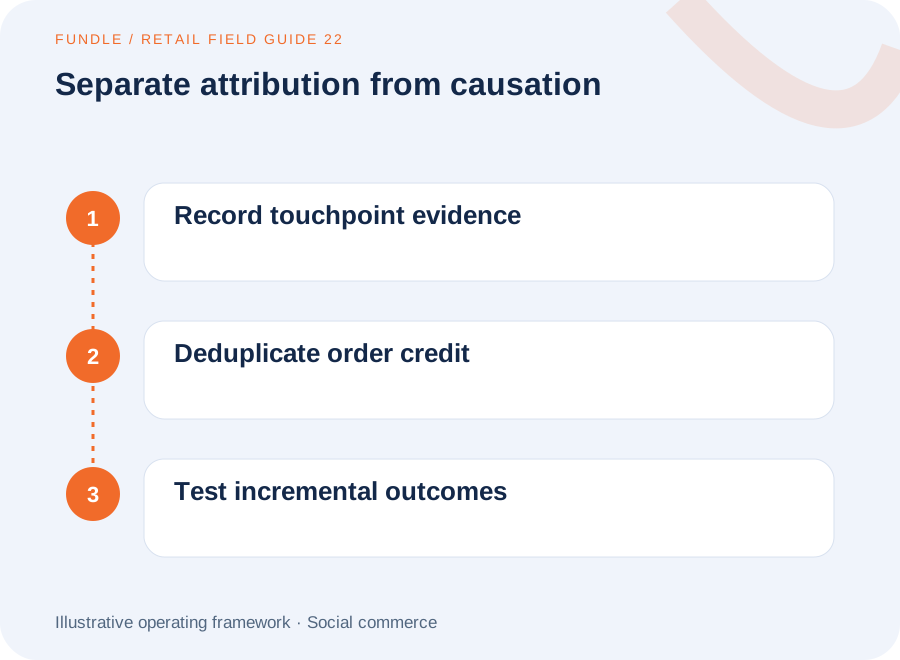
Social-commerce attribution versus incrementality: measure different questions
What is the difference between attribution and incrementality in social commerce?
Attribution assigns credit for an observed order according to a chosen rule; incrementality estimates how many outcomes happened because of an intervention rather than without it. Social-commerce teams need both. Use reconciled orders and explicit attribution settings for channel reporting, then a suitable comparison design to evaluate additional customers, contribution and the effect of campaign cost.
Two numbers can be correct and answer different questions
A shopper sees a social post, asks a question in a message, receives store assistance and buys online. Several teams contributed to the journey. Attribution decides how the recorded order is credited among eligible interactions. It does not automatically establish whether the order would have happened without the campaign.
Incrementality asks that counterfactual question. The commercial decision is whether spending on the intervention creates enough additional value to justify the cost. Keep the two questions separate in the monthly review so a large attributed total cannot silently become a claim about caused revenue.
Make the attribution rule reproducible
Record the eligible touchpoints, identity method, attribution model, lookback window and order outcome being credited. Decide whether cancelled and refunded orders remain in the reported value. Preserve the settings with each reporting period so a configuration change is not mistaken for better marketing.
Google Analytics attribution settings describe the role of the lookback window in determining how far back a touchpoint is eligible for credit. This is a platform-specific measurement setting. In your own social-commerce review, the recommendation is to name the actual window and rule instead of presenting an unexplained social revenue total.
A conversation may be matched to a later order only where the identity link is reliable and permitted. Keep unmatched orders visible. Do not distribute them across channels simply to make the attribution percentages add to a desired result.
Choose the causal question before designing the test
Define the intervention precisely: a paid campaign, an associate follow-up, an offer or a new message sequence. Decide which people or stores are eligible and what differs between treatment and comparison. If one group receives a discount and another receives no message, the test estimates the combined intervention, not the isolated effect of the creative.
Google’s Conversion Lift explanation explicitly distinguishes incremental conversions measured against a held-back group from attributed conversions governed by tracking settings. That supports the conceptual distinction. It does not mean every account, social channel or retailer can use that particular product; the comparison must fit the operation.
For an owned eligible audience, random assignment can provide a useful starting point. Decide assignment before the campaign and analyse the people assigned, including non-openers. Checking only responders introduces selection because response itself can be affected by the intervention.
Use a measurement contract
| Decision | Attribution view | Incrementality view |
|---|---|---|
| Unit | Order or credited outcome | Assigned customer, household or store |
| Reference | Eligible recorded interaction | Comparable outcome without the intervention |
| Time | Lookback and reporting windows | Predetermined exposure and outcome windows |
| Returns | Explicit revenue reversal treatment | Same completed-outcome rule in both groups |
| Cost | Channel spend associated with credited orders | Incremental contribution after intervention cost |
| Interpretation | Where credit was assigned | Estimated additional value under design assumptions |
The contract should also define identity conflicts, missing outcomes and overlapping campaigns. If the comparison group receives a similar offer through another team, record the contamination instead of assuming the original test remains clean.
A worked hypothetical example
Assume 10,000 eligible customers are randomly assigned: 8,000 to a campaign and 2,000 to a holdout. Over the predefined outcome window, 800 assigned treatment customers and 180 assigned holdout customers make a qualifying retained purchase. Each customer is counted at most once, and both groups use the same return-adjustment rule.
Treatment purchase rate is 800 ÷ 8,000 = 10%. Holdout purchase rate is 180 ÷ 2,000 = 9%. The observed absolute difference is one percentage point. Applying the holdout rate to the treatment population gives 8,000 × 9% = 720 expected purchasers without the intervention. The illustrative incremental estimate is therefore 800 − 720 = 80 purchasers.
Suppose the attribution report credits 500 purchasers to the campaign. That does not contradict the estimate of 80 incremental purchasers: the reports answer different questions. If the average contribution from an incremental retained purchaser is assumed to be ₹300, estimated additional contribution is 80 × ₹300 = ₹24,000. Subtracting ₹12,000 of intervention cost leaves ₹12,000 in this simplified scenario.
These are point estimates under stated assumptions, not a statistically established result. Review uncertainty, balance, missing outcomes and contamination before making a budget decision. Do not use the example’s rates as a benchmark for your business.
Count costs without subtracting them twice
Define contribution before and after the campaign. If the per-purchaser contribution already deducts discounts, fulfilment and reward cost, do not subtract those same items again. If it excludes communication cost, include that separately. Return-adjusted revenue is still not contribution until the relevant variable costs are considered.
A campaign may create purchases that would otherwise occur later. Extend observation appropriately for the buying cycle and inspect whether an initial gain is followed by a decline. For considered purchases, a short measurement window may miss later completions. For frequent purchases, overlapping promotions may make the comparison harder to isolate.
Know when the design cannot answer the question
Small audiences, poor identity links and large store differences can leave uncertainty too wide for a strong conclusion. A before-and-after comparison is particularly vulnerable to seasonality, assortment changes, festivals and concurrent offers. Use it as descriptive evidence when a stronger design is unavailable, with the limitation stated plainly.
Do not call a campaign incremental because it has a unique coupon. The coupon can improve traceability, but customers who would have purchased anyway may also redeem it. Similarly, a high click-to-order ratio describes the responding population; it does not create a counterfactual.
Practical experiment checklist
- Name one intervention and the business decision the result will inform.
- Freeze eligibility, assignment and outcome definitions before launch.
- Check identity, source coverage and comparable return treatment.
- Monitor concurrent campaigns and cross-group contamination.
- Analyse all assigned units under the stated design.
- Review uncertainty and contribution before reallocating spend.
- Keep the attribution report as a separate operational view.
Explore campaign evaluation with retail intelligence. Request a Fundle workflow walkthrough that keeps attributed orders, experimental assignment and return-adjusted outcomes distinct. Confirm which source records and comparison logic can be supported before asking the interface to recommend the next budget move.
Questions from retail teams
Can attributed revenue be higher than incremental revenue?
Yes. Attribution may credit orders from people who would have purchased even without the intervention. Incrementality estimates the additional outcome against a comparison. The totals can differ substantially without either report being internally wrong. Check definitions, outcome windows and uncertainty before using either number in a commercial decision.
Does a unique coupon prove that a campaign caused the order?
No. A coupon identifies a redemption path but does not show what the customer would otherwise have done. Existing demand can also use the offer. To estimate additional impact, compare appropriately defined outcomes against a credible alternative condition while accounting for eligibility, overlapping promotions, returns and the cost of the incentive.
Should the holdout contain only customers who would open the message?
No. Defining the comparison through a response that occurs after assignment can bias the result. Start with the eligible population and a suitable assignment method, then analyse according to the predefined design. Non-openers and non-buyers are part of understanding the effect of offering the intervention to that audience.
What if our audience is too small for a reliable lift estimate?
Report the uncertainty and use the pilot to learn about delivery, identity, offer relevance and operational friction. Consider a longer suitable observation period or a different design with expert review. Avoid converting an unstable point estimate into a confident revenue forecast simply because the dashboard displays a positive percentage.
How should social messages and paid ads be tested together?
Define whether the question concerns the combined journey or the separate contribution of each intervention. A combined test cannot automatically isolate the effect of the message versus the ad. Track exposure overlap and choose a design that matches the decision, with enough volume and consistent outcomes across the relevant groups.
Sources and further reading
- Google Analytics attribution settings — Documents the role of lookback windows in attribution eligibility; does not establish causality.
- Google Ads understanding Conversion Lift — Primary explanation separating held-back comparison-based incrementality from standard attributed conversions. Hypothetical experiment is original.