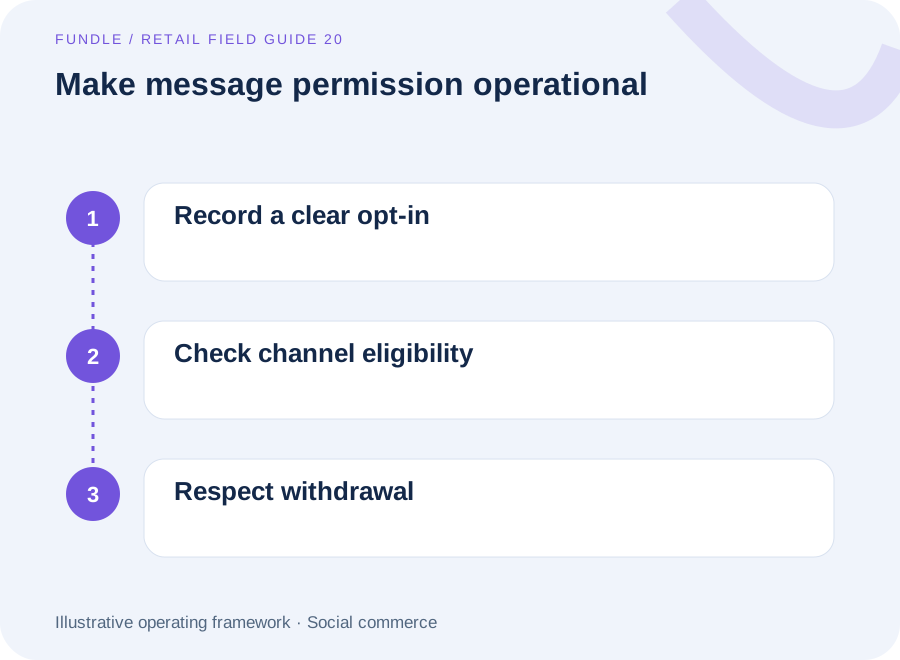
Social commerce opt-in and message governance for retail teams
How should retailers govern opt-in and follow-up messages in social commerce?
Retailers should distinguish a service enquiry from permission for future marketing, retain evidence of the customer’s choice, and check eligibility again before sending. Connect preferences and withdrawals to every relevant audience, define the owner of each message, and keep platform rules separate from internal campaign decisions. A stored phone number or previous purchase does not by itself establish permission for every follow-up.
Give every message a clear job
A customer asking whether a jacket is available needs a useful answer. That conversation does not automatically justify a long sequence of unrelated offers. Begin by classifying the proposed communication: responding to the enquiry, fulfilling an agreed transaction, sending a requested reminder or promoting another purchase. Record the purpose before selecting the channel or message format.
For an Indian retailer, different storefronts, support teams and campaign tools may all hold part of the relationship. A central marketing list will not prevent unwanted contact if an associate’s follow-up queue uses an older copy. Governance therefore needs an operating process that carries changes to the actual sender, not merely a preference field on a profile.
Use current channel policy as a starting point
The WhatsApp Business Messaging Policy requires the recipient’s contact details and opt-in permission for subsequent contact, and requires opt-out requests to be respected. Its Business Platform terms distinguish approved-template initiation from replies within the customer-service window. These are documented platform conditions; the operating design below is a recommendation for applying appropriate checks to a retail workflow.
Shopify’s contact-information guidance likewise distinguishes collecting contact details from a customer agreeing to marketing. Do not treat a checkout field, social follow, receipt request or imported contact as a universal permission token. Confirm which customer choice is recorded and what the current channel supports.
Create a permission record with useful evidence
Keep the customer identifier, contact point, relevant purpose, choice, collection source, time and the notice or wording version presented. Record changes as events rather than silently overwriting the previous value. An analyst should be able to explain why a recipient qualified when an audience was prepared and whether that qualification remained valid at send time.
Avoid a single ambiguous column called consent. It may mix email subscription, WhatsApp marketing, order updates and an employee’s manual assumption. Use purpose and channel distinctions appropriate to the actual programme. If the record is incomplete, route it for review or exclude it from the affected marketing audience; do not fill the gap with an inferred approval.
Define the decisions at each handoff
| Handoff | Evidence the owner needs | Decision to record |
|---|---|---|
| Enquiry to service response | Original question and relevant channel state | Answer, clarify or route to a person |
| Service to future marketing | Applicable opt-in evidence and purpose | Eligible or excluded |
| Audience preparation to approval | Current preferences, recent contact and offer rules | Approve the specific proposed audience |
| Approval to dispatch | Latest suppression state and supported message route | Send or stop each queued message |
| Withdrawal to downstream systems | Customer identity, request time and affected purpose | Suppress, confirm propagation and resolve failures |
A campaign approval should identify the message, audience definition and intended timing. Editing the offer or expanding the cohort after approval should create a reviewable change. This keeps the operating decision concrete without making routine teams navigate an unnecessary approval maze.
A worked hypothetical suppression example
Assume a retailer has 1,000 unique candidate contacts for a category campaign. Two hundred lack the required permission evidence, 80 have an opt-out recorded, and 40 appear in both groups. The excluded union is 200 + 80 − 40 = 240 contacts. That leaves 760 potentially eligible contacts before the commercial rules are applied.
Among those 760, another 60 purchased too recently under the campaign’s exclusion rule. The prepared audience is therefore 700. Before dispatch, ten members withdraw the relevant permission. A fresh suppression check reduces the sendable audience to 690. All counts are hypothetical and assume reliable identity matching, no other overlaps and no further exclusions.
The important control is not the percentage removed. It is whether the ten later changes reach the dispatch process. Reporting the original 700 as the final audience would hide a real operational failure even if the message copy was approved correctly.
Make withdrawal operationally complete
Accept a clear request wherever the customer makes it through a supported service path. Give the receiving team an obvious way to record the request and its scope. Avoid requiring an associate to interpret a complicated data model while handling a live conversation. Keep the underlying event precise even when the frontline form is simple.
Identify every destination that can initiate the affected communication: campaign platform, store task queue, outsourced service team or scheduled export. Record propagation status and failed updates. Define a conservative fallback for queues that cannot refresh reliably. A customer should not need to repeat the same instruction because two teams use different lists.
Measure the control, not just the audience size
Track permission-evidence completeness among candidate records, the age of suppression updates and queued messages stopped after a preference change. Use distinct denominators. For example, evidence completeness is assessed on the relevant candidate population, while propagation success is assessed on required downstream updates. Do not combine them into one unexplained compliance score.
Inspect message complaints, blocks and opt-outs in the context of purpose, frequency and source. A low-volume campaign can still have poor relevance. A high opt-in count can conceal unclear wording. Sample the actual collection journey and message sequence before concluding that the process is healthy.
Practical launch checklist
- Classify service, transaction and promotional purposes explicitly.
- Verify the collection wording and the evidence retained for each relevant choice.
- Test one withdrawal through every sender and scheduled queue in scope.
- Review the current platform route, template requirements and escalation path.
- Apply identity, recent-contact, purchase and offer exclusions consistently.
- Confirm the final audience and message version at dispatch.
- Record failed updates and give each exception an accountable owner.
These controls support a reviewable operating process; they do not replace assessment of the organisation’s applicable requirements. Keep the business and responsible legal teams involved in defining the actual permission model and customer notices.
For evaluation, connect the customer-choice workflow with campaign management. Request a Fundle workflow walkthrough showing a preference collected, changed and propagated into a prepared audience. Ask what happens to a queued message after a late withdrawal and which systems require a separate integration or operating step. Confirm demonstrated behaviour before relying on it.
Questions from retail teams
Does a customer enquiry permit future promotional follow-ups?
Do not infer a broad future marketing permission from an enquiry. Preserve the original service purpose and check the applicable customer choice and current channel conditions for the proposed next message. The practical test is whether the team can explain why that particular recipient should receive that particular communication at that time.
What evidence should a store retain for an opt-in?
Retain enough to identify the customer and contact point, the relevant purpose, the choice made, when and where it was collected, and the wording or notice version presented. Protect access to that evidence. A bare yes field is difficult to interpret when the collection journey or message purpose later changes.
How should a retailer handle a withdrawal received by a store associate?
Provide a simple recording route that preserves the customer identity, request time and affected communication. Carry the update to every relevant sender and queue, and track failures. The associate should know who owns unresolved propagation. Avoid treating the request as complete merely because one local contact list was edited.
Why check permissions again after the campaign is approved?
The customer’s preference can change between audience preparation and dispatch. A current check prevents an earlier approval from becoming a stale justification for contact. Record the final sendable population and explain material differences from the approved audience. Keep commercial exclusions and channel eligibility current at the same decision point.
Can one vendor setting establish messaging compliance for the business?
A setting can support part of the process, but the organisation still needs appropriate collection journeys, notices, purpose definitions, suppression propagation and operating ownership. Evaluate the actual connected workflow and obtain the relevant internal review. Do not describe a product label or a checked box as proof of compliance across all communications.
Sources and further reading
- WhatsApp Business Messaging Policy — Current policy reviewed includes recipient permission, opt-out handling and Business Platform initiation/reply rules. Policy-specific paraphrase limited; recommendations are editorial.
- Shopify collecting customer contact information — Documents the distinction between contact collection and marketing agreement; not advice on Indian legal compliance.