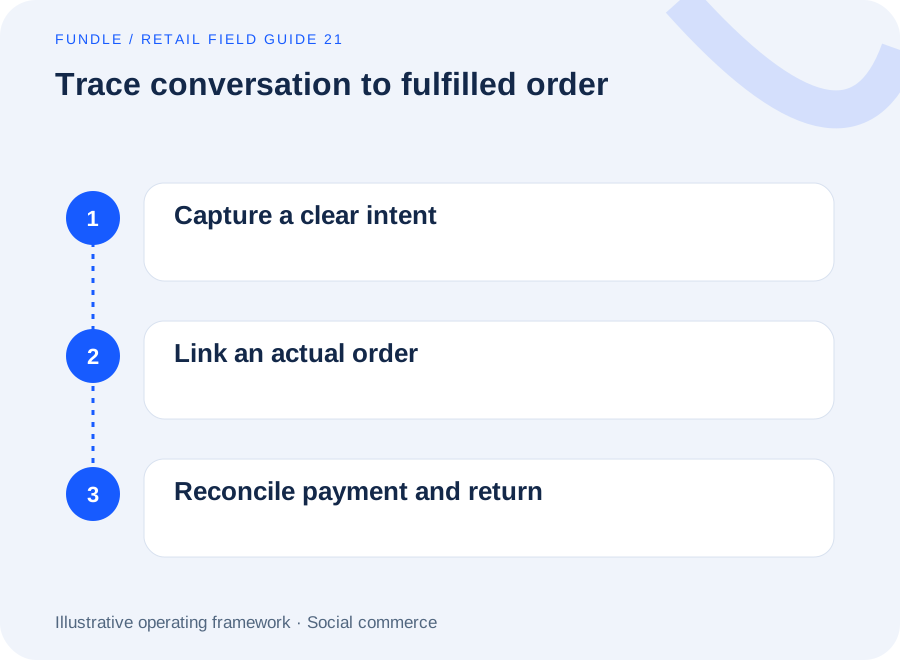
Turning social conversations into reconciled retail orders
How can retailers turn social conversations into reconciled orders?
Create a traceable handoff from conversation to an authoritative order record, then connect payment, fulfilment and refund events using stable identifiers. Keep enquiry, quotation, checkout, paid order and completed sale as separate states. Reconcile values and exceptions at the appropriate grain so an enthusiastic reply, payment screenshot or repeated webhook cannot silently become duplicated revenue.
Start with a state model, not a chat count
A social conversation may contain several product questions, a revised quantity and a delivery request. It can also end without a purchase. The operating challenge is to preserve that intent while moving the agreed transaction into the system that owns orders and payments. Counting messages or interested customers as sales hides where the handover actually fails.
Define the states your team can verify: enquiry received, requirement qualified, quote prepared, checkout offered, order created, payment confirmed, fulfilment completed and refund processed. Some businesses will need reservation, partial payment or cash-on-delivery states. Only include states supported by the real operation, and identify which system is authoritative for each.
Give identifiers different jobs
Use a conversation identifier to retain the service context and an enquiry identifier when one thread contains multiple buying needs. Link those to the order identifier once the transaction is created. Preserve order-line identifiers for products and separate payment references for individual financial events. A phone number alone is not a dependable order key.
The Shopify draft-order documentation provides one concrete handover pattern: staff can prepare a draft, send an invoice with a checkout link, and the paid draft becomes a regular order. That documents Shopify behaviour. It does not establish that Fundle or any other connected service supports the same operation without implementation work.
Keep the original channel and campaign context attached where supported. Use an explicit attribution record rather than rewriting the order source whenever the shopper returns through another channel. The financial record should remain stable even when the marketing interpretation changes.
Design a reconciliation table
| Record | Minimum key and value context | Common mistake to prevent |
|---|---|---|
| Enquiry | Enquiry ID, conversation ID, need and owner | Treating repeated messages as new leads |
| Order | Order ID, currency, line items and agreed total | Creating a second order after a retry |
| Payment event | Provider reference, order link, state and amount | Accepting a screenshot as settlement evidence |
| Fulfilment | Shipment or collection reference and items | Calling a paid but cancelled order completed |
| Refund | Refund reference, original order and affected amount | Subtracting the same reversal twice |
| Settlement | Payout reference, included payment events and fees | Expecting the payout to equal gross orders |
Specify which timestamps are event time, system receipt time and reporting time. This distinction helps explain a payment received before the overnight order import without inventing a missing sale.
Preserve the shopper’s agreement
The checkout or approved order document should reflect the agreed product, quantity, delivery charges, discount and service terms. If the conversation changes those details, update the authoritative record through a controlled step and retain the version that was accepted. Do not ask finance to reconstruct the transaction from scattered screenshots at month-end.
Confirm availability before promising collection or delivery. A product shown in a social post is not necessarily current stock. If a store must confirm the item, give that store an owner, a response expectation and the customer’s relevant requirements. Keep the response connected to the original enquiry.
A worked hypothetical reconciliation
Assume one day produces 100 unique social enquiries. Forty become draft quotes and 30 become confirmed orders. Twenty-eight orders have verified payments of ₹2,000 each, totalling ₹56,000. Two remain unpaid. During the chosen reporting window, three of the paid orders are fully refunded, totalling ₹6,000. This simplified example excludes tax differences, shipping adjustments and partial refunds.
Retained paid order value is ₹56,000 − ₹6,000 = ₹50,000, representing 25 orders. If the payment provider deducts ₹1,000 in applicable fees and all included events settle in the same payout, the expected payout is ₹49,000. The example’s enquiry-to-retained-order ratio is 25 ÷ 100 = 25%, not the 30% implied by counting all confirmed orders.
A payout of ₹47,000 would create a ₹2,000 difference to investigate, not an automatic recovery claim. Check settlement timing, reserves, additional adjustments and source completeness first. A single missing payout event could explain the difference without any order being wrong.
Keep analytics events separate from the ledger
Google’s ecommerce measurement guide describes purchase and refund events, including linking refunds through the transaction identifier and item information. That is useful measurement plumbing. An analytics event remains a reporting signal; the business should use its authorised order and payment sources to resolve money movements.
Define idempotency rules for imports and callbacks so retries do not create another order or payment. Retain failed and unmatched events in a review queue. If a customer changes channels, link the conversation where identity and permissions permit, but do not duplicate the underlying financial event merely to give both teams visibility.
Run two operating queues
The customer queue should show questions, unconfirmed availability, incomplete checkouts and promised callbacks. The financial queue should show unmatched payments, value differences, pending refunds and settlement exceptions. A customer-service employee and a finance reviewer need different evidence, although both may work on the same order.
Age exceptions from the event that requires action. An old enquiry with a new customer reply is not necessarily an overdue payment. Set ownership and closure criteria for each queue, and record why an exception was resolved. Closing a task should not erase the original source evidence.
Practical order-handover checklist
- Confirm one authoritative order and one stable order identifier.
- Preserve the accepted products, price, charges and delivery terms.
- Verify payment through the approved source rather than customer-supplied proof alone.
- Handle retries, split payments and partial refunds without duplicating value.
- Reconcile the payout window and fees before classifying a difference.
- Keep enquiry, payment and fulfilment outcomes separately reportable.
- Sample a cancelled order and a refund through the complete trace.
Explore lead-to-order context and connected ecommerce journeys. Request a Fundle workflow walkthrough from an initial social enquiry through an amended order and a refund. Confirm which records can be connected, which actions need another system and how exceptions remain visible to the responsible team.
Questions from retail teams
Is a customer payment screenshot enough to mark an order paid?
Use the approved payment source to verify the event and its relationship to the order. A screenshot can help investigate a customer question but may be incomplete, duplicated or refer to another transaction. Define who can change payment status and retain the verified reference, amount, currency and event time.
What if one conversation creates two separate orders?
Keep one conversation record linked to two distinct order identifiers, with the relevant enquiry or quotation context for each. Do not force a one-thread-to-one-order model. This preserves service continuity while allowing payments, fulfilment and refunds to be reconciled correctly for each separate commercial transaction.
How should cash-on-delivery orders appear in the social funnel?
Give them a distinct payment and fulfilment state supported by the business process. An order placed is not collected cash, and a shipped order is not necessarily delivered. Reconcile delivery confirmation, collection and any provider remittance separately. Use a completed-outcome definition that reflects those differences when comparing channels.
Why might a payment-provider payout be lower than paid orders?
The payout can cover a different event window and include refunds, fees, reserves or other documented adjustments. Reconcile the included payment events before treating the difference as an error. Preserve the provider reference and calculation so the reviewer can reproduce the expected amount and classify any remaining unexplained variance.
Can a social campaign receive credit when checkout happens on the website?
It may receive attribution credit under a documented rule when the relevant source and identity context are available. That marketing interpretation should not create another order or change verified revenue. Preserve the source evidence and attribution settings, and distinguish credited orders from sales proven to be incremental to the campaign.
Sources and further reading
- Shopify draft orders and invoices — Documented draft-to-checkout-to-paid-order pattern in Shopify; implementation elsewhere must be verified.
- Google Analytics ecommerce measurement — Purchase/refund events and transaction/item identifiers for analytics. Financial reconciliation and example are original editorial guidance.