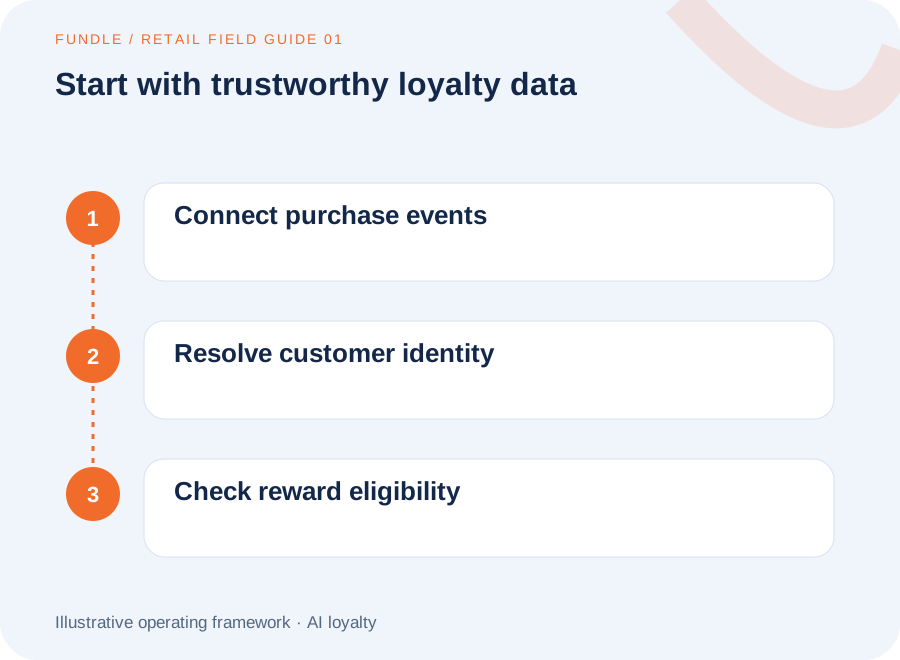
Is your retail data ready for AI-powered loyalty?
What data does a retailer need before using AI for loyalty?
AI-powered loyalty needs reliable customer identities, item-level transactions, returns, reward movements and current channel permissions. Start with one decision, such as identifying eligible first-time buyers for follow-up. Reconcile its source data, document exclusions and test the proposed audience before activation. A large customer database is less useful than a smaller, traceable dataset with clear ownership and refresh rules.
Start with a decision that can be checked
Before connecting every store system, write the first question your loyalty team must answer. A useful starting point is: which customers made their first qualifying purchase in the last month, have not returned it, and can receive an appropriate follow-up? This question exposes the required evidence. It needs purchase history, an agreed meaning of qualifying, identity continuity, returns and permission status. It does not initially need a predictive model.
Agree who will act on the answer and what a wrong answer would cost. Sending a welcome offer to a long-standing customer wastes money; contacting an opted-out customer breaches their expressed preference. Different mistakes therefore need different release gates. Treat readiness as fitness for a specific decision, rather than a badge awarded to an entire database.
Keep each business event at its own grain
A transaction header is one bill. A line item is one product on that bill. A customer is a person or approved account identity. A reward movement is an earning, redemption, expiry or reversal. Joining these tables without respecting their grain can multiply revenue and points. Three product lines must not turn one ₹2,000 bill into ₹6,000 of customer spend.
Google's ecommerce measurement documentation distinguishes purchase and refund events and supports item details and transaction identifiers. That is a useful event-design reference, not a replacement for POS reconciliation. Your finance-approved transaction records should resolve differences between web tracking and completed sales.
| Record | Minimum useful fields | Check before use |
|---|---|---|
| Purchase header | Source, bill ID, store, time, net value | Unique within its source |
| Purchase line | Bill ID, SKU, quantity, discount | Lines reconcile to the header |
| Return | Original bill and line, quantity, amount | Cannot exceed eligible original quantity |
| Customer link | Internal ID, source ID, match evidence | Ambiguous links remain unresolved |
| Reward movement | Movement ID, reason, rule version | Opening plus movements equals closing |
| Permission | Person, channel, purpose, state, time | Current state available at activation |
Separate missing data from negative behaviour
No observed purchase is not always evidence of inactivity. A customer may have visited a store whose feed stopped arriving, bought through a channel without usable identity, or changed their phone number. Record coverage by store and date before computing recency. A churn flag should carry a coverage warning when the observation window is incomplete.
Use both event time and arrival time. An offline store may upload yesterday's sales today. Preserve the original trading date and the ingestion timestamp so teams can tell delayed reporting from new behaviour. Define the timezone and treatment of transactions after midnight consistently. Retail operations should approve the business-day convention before analysts compare stores.
Identity confidence belongs beside the customer link. Verified account connections, manual corrections and uncertain similarities are different kinds of evidence. Keep uncertain matches outside individually targeted audiences until resolved. Do not allow an AI-generated explanation to quietly convert a probable match into a confirmed person.
Reconcile the reward ledger independently
A loyalty balance should be explainable from movements. Opening balance plus earned points, less redeemed and expired points, adjusted for approved reversals, should equal the closing balance. Preserve the programme rule that applied when each movement occurred. Otherwise a later rule change can make historical balances impossible to reproduce.
Test a partial return, a cancelled sale, a duplicate bill import and a redemption followed by a return. These cases often reveal more than a successful purchase does. Programme owners must define the customer-facing resolution where points have already been spent. The data team should implement approved rules, rather than inventing debt or clawback policies while cleaning records.
Worked hypothetical example: qualify a pilot dataset
Assume a retailer receives 10,000 transaction-header records for a pilot period. Of these, 200 are exact retransmissions. Deduplication leaves 9,800 unique purchases. A further 300 lack a resolvable customer identity, leaving 9,500 identifiable purchases. Identity coverage is therefore 9,500 divided by 9,800, or approximately 96.94%; it is not 95% simply because the original file contained 10,000 rows.
Within those 9,500 identifiable purchases, recorded sales after invoice discounts total ₹20,00,000. Linked returns total ₹50,000, producing ₹19,50,000 after returns on the same value basis. These are illustrative amounts, not a customer result. They do not establish campaign profitability because reward costs and other variable costs have not been considered.
The pilot team accepts the identifiable purchase subset for descriptive analysis. It excludes unresolved identities from customer messaging and routes them for correction. It does not claim that the excluded sales vanished. The report retains their count and value as an explicit coverage gap.
Set release gates with accountable owners
Choose tolerances around the decision's consequences. A missing product colour may be acceptable for total-spend reporting but unacceptable for a colour-specific recommendation. Assign each issue an owner, a resolution deadline and a fallback. A failed return feed could suspend incentive recommendations while still allowing a store-level sales completeness report.
NIST's AI Risk Management Framework presents voluntary guidance for considering trustworthiness throughout AI use and evaluation. For this workflow, our recommendation is a release record containing the data snapshot, checks, exclusions, approved purpose and accountable reviewer. That record makes a recommendation reviewable even when the underlying model changes.
Pilot readiness checklist
- Name the first loyalty decision and its accountable business owner.
- Document bill, item, customer and reward grains before joining tables.
- Reconcile totals and returns against the agreed source of record.
- Publish coverage, freshness and identity exceptions beside every audience.
- Verify reward rules and channel permissions using realistic edge cases.
- Run a dry audience build, inspect a sample and retain the approval evidence.
Use Loyalty and CLM and Fundle Brain as starting points for a workflow discussion. Request a Fundle walkthrough using your own data definitions and exception cases. Confirm available connections, review controls and activation steps during evaluation before treating them as deployment capabilities.
Questions from retail teams
Do we need several years of purchase history before starting?
Not for every decision. A descriptive pilot can start with a shorter, reconciled period if its limitations are visible. However, identifying a genuinely first-ever purchaser or estimating seasonal repeat behaviour requires a longer observation window. State the historical coverage explicitly and avoid calling a customer new when you only know they are new to the available dataset.
Should unmatched store transactions be deleted from the loyalty dataset?
Keep them in the transaction record and report them as unmatched. They still contribute to store sales and coverage analysis. Exclude them from person-level activation until identity is resolved, rather than forcing a match. Maintaining the unresolved records allows later reconciliation without rewriting the original sales history or concealing the size of the gap.
What is the difference between a customer table and a reward ledger?
The customer table describes identities and attributes. The reward ledger records individual balance movements with reasons, times and rule references. A current points balance alone cannot explain how that balance arose. Keeping movements separately lets operations investigate reversals, duplicate earning and disputed redemptions without guessing from a customer profile snapshot.
How should an AI answer handle a late POS feed?
It should identify which stores or periods are incomplete and limit the conclusion accordingly. For example, a repeat-purchase audience may need to wait until the missing transactions arrive. An analyst can still review the available subset, but the interface should not present that subset as complete enterprise coverage or label missing activity as customer churn.
What should we bring to a Fundle data-readiness walkthrough?
Bring anonymised example records, a field dictionary, reconciliation totals, programme rules and a small set of known exceptions. Include one partial return and one duplicate import. Ask the team to explain how the proposed workflow handles them and which steps require configuration, integration or human review. Agree the pilot acceptance criteria before discussing wider rollout.
Sources and further reading
- Google Analytics: Measure ecommerce — Documented purchase/refund event distinction, transaction IDs and item parameters. Readiness gates and ledger design are original recommendations.
- NIST AI Risk Management Framework — Voluntary trustworthiness and AI evaluation framework; the proposed retail release record is editorial guidance.