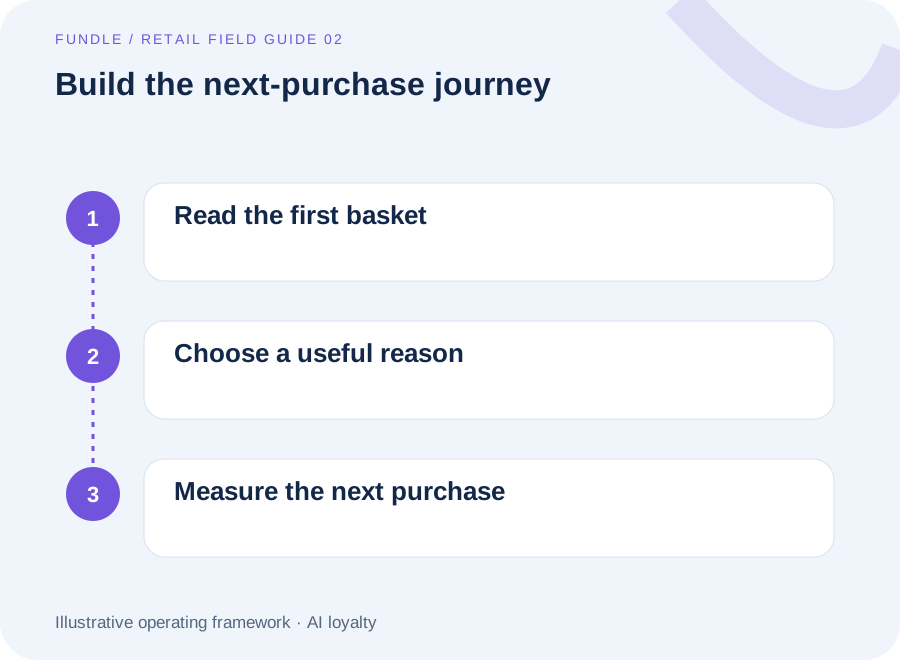
Design a loyalty journey that earns the second purchase
How should a retailer design a second-purchase loyalty journey?
Begin with a clearly defined first qualifying purchase, then choose a useful follow-up based on the category, fulfilment status and customer permissions. Measure second purchase within a fixed period from that first purchase, comparing customers at the same journey age. Test service, advice or relevant benefits before assuming that every new buyer needs a discount to return.
Define the second purchase before designing messages
A second-purchase journey should help a shopper find another relevant reason to buy. It should not begin with a calendar full of messages. First agree what counts as the first purchase, what counts as the second and when the measurement window starts. An exchanged size, a replacement for a damaged item and a separately billed delivery should not automatically become successful repeat demand.
Choose a qualifying purchase rule that your order and POS systems can reproduce. Record the original order, cancellation status and returns. Define how returns affect qualifying-order status before enrolment. Once customers are assigned to an experiment, retain them in their assigned population and treat later returns as outcomes. Keep the original acquisition record available so the team can investigate service problems rather than simply erasing difficult journeys.
Compare customers at the same journey age
Someone who bought yesterday has had less opportunity to return than someone who bought six weeks ago. A monthly dashboard can hide this difference. Measure the proportion of a first-purchase cohort making a second qualifying purchase within a stated interval, such as 30 days. Only include customers who have completed that follow-up interval in the final comparison.
Shopify's customer-report documentation describes cohorts grouped by first-order date and intervals measured from that order. The operational lesson is to preserve customer age when comparing journeys. A newer cohort's unfinished period should appear as incomplete, rather than as a zero-retention result.
Keep acquisition channel, first category, initial discount and fulfilment method available for interpretation. These are useful pre-existing characteristics. Do not split the final results only by who opened a message: opening occurs after treatment and can create a selected comparison that hides the experience of non-openers.
Design around the reason a shopper might return
The right next step depends on the product and the relationship. A furniture buyer may need installation support long before another sofa. A skincare buyer may need clear usage guidance before replenishment becomes relevant. An apparel buyer may value an available complementary item or a store styling appointment. Use observed patterns as hypotheses, then check whether customers find the intervention helpful.
| Customer situation | Useful next step to test | Signal that should pause promotion |
|---|---|---|
| Product just delivered | Care or setup guidance | Delivery dispute |
| Purchase needs fitting | Accessible fitting support | Unresolved exchange |
| Replenishable category | Timely replenishment reminder | Recent repeat purchase |
| Complementary need | Relevant, available accessory | Poor stock coverage |
| Unclear preference | Optional preference collection | Customer declines contact |
Avoid treating a single purchase as proof of a permanent preference. A gift purchase does not establish the buyer's own size, gender or routine. Where the inference matters, ask for a preference rather than inventing one. The journey should remain useful when customer information is sparse.
Build a short, interruptible journey
Use a small number of meaningful stages: confirmation of the relationship, support with the purchase, a relevant return opportunity and a review of outcomes. The exact timing should reflect the category and fulfilment process. Do not copy a universal seven-day discount sequence across groceries, jewellery and consumer electronics.
Every stage needs entry and exit conditions. A new purchase should remove the customer from a first-to-second-purchase promotion. An unresolved complaint should route the customer toward service. A withdrawn permission should stop the applicable marketing channel. Preserve these transitions in the journey log so operators can explain why a planned communication was cancelled.
Record the proposed message, actual dispatch and outcome separately. A queued message may fail delivery; a delivered message may remain unread. These distinctions help operations diagnose the journey, but the main experimental outcome should still use the original assigned population when estimating the effect of offering the journey.
Worked hypothetical example: test a useful follow-up
A retailer enrols 1,600 eligible first-time customers at their first qualifying purchase. It randomly assigns 800 to a new follow-up journey and 800 to its existing experience. Both groups retain their promised loyalty benefits, and every customer receives a complete 30-day follow-up period before the result is finalised. The additional journey combines care guidance with a relevant return invitation; it is not presented as a proven Fundle result.
Within 30 days, 112 customers in the journey group make a qualifying second purchase, compared with 88 in the comparison group. Their rates are 112 divided by 800, or 14%, and 88 divided by 800, or 11%. The observed difference is three percentage points. Applied to the 800 assigned journey customers, that difference represents 24 additional repeat buyers in the point estimate.
The relative difference is approximately 27.27%, calculated as three divided by eleven. It does not mean every repeat purchase was caused by the journey. Nor does the calculation alone establish statistical reliability. Review uncertainty, returns and contribution before deciding whether to scale. A more expensive repeat basket is not necessarily a more profitable relationship.
Read the result beyond a single conversion
Track net contribution per assigned customer alongside second-purchase rate. Use the same cost treatment in both groups, including incremental messaging and benefits. Also monitor time to second purchase, cancellation and return rates, support contacts and opt-outs. These measures can reveal a journey that pulls demand forward without improving longer-term value.
Google's Conversion Lift guidance explains the use of treatment and comparison groups to estimate causal advertising effects. The retailer-run journey above applies the comparison principle; it is not a claim that this particular Google product measures the loyalty workflow. Keep the campaign's own assignment and outcome records independently reviewable.
Launch checklist for the lifecycle team
- Specify qualifying orders, replacements, returns and the observation window.
- Segment by first-category needs and verified pre-existing information.
- Write a helpful message for each stage, with one clear customer action.
- Test exits for second purchase, complaint, stock loss and permission changes.
- Freeze the comparison plan before looking at commercial outcomes.
- Review contribution and customer friction before increasing message volume.
Explore Loyalty and CLM alongside campaign management to frame the workflow. Request a Fundle walkthrough of your actual journey rules, including how a second purchase or unresolved exchange changes the next recommendation. Verify the required data connections and execution controls during that discussion.
Questions from retail teams
Should the second-purchase offer always be a discount?
No. Start with the customer need created by the first purchase. Care guidance, fitting support, relevant availability or an appropriate reminder may be more useful than a price incentive. Compare the additional intervention with the existing experience, and judge the result using contribution and customer response rather than assuming that a higher redemption rate means stronger loyalty.
How long should the second-purchase window be?
Choose a window that fits the category and the decision you are evaluating. Review observed purchase intervals, delivery timing and seasonality, then specify the window before analysing the test. Use equal follow-up for all customers. A short window can measure immediate response, but it cannot by itself establish whether the journey improves longer-term retention.
Can an exchange count as a second purchase?
It depends on the agreed definition, but a replacement or size exchange should normally be identified separately from new demand. Link it to the original transaction so it does not inflate the repeat-purchase metric. If an exchange includes an additional paid item, define beforehand whether that incremental purchase qualifies and apply the same rule across comparison groups.
What happens when a customer buys again before the next message?
Remove them from the first-to-second-purchase promotion and reassess their next useful step. A queued discount reminder can be confusing immediately after a purchase. Preserve the original assignment for experiment analysis, while recording that the operational journey correctly stopped or changed. This separates responsible execution from selective removal of successful customers in the final measurement.
How can we evaluate a journey with a small customer base?
Use fewer variants and a clearly defined outcome so the available sample is not fragmented. Estimate the uncertainty around the result and avoid declaring success from a handful of repeat purchases. You may need a longer enrolment period or several comparable cohorts, while keeping the same rules and allowing each customer the full observation window.
Sources and further reading
- Shopify Help Center: Customers reports — Documents first-order cohorts and observation intervals; suggested journey stages and category choices are editorial recommendations.
- Google Ads: About Conversion Lift — Documents the treatment/control principle for advertising incrementality. The retail journey experiment is an original hypothetical design, not a claimed Google or Fundle integration.