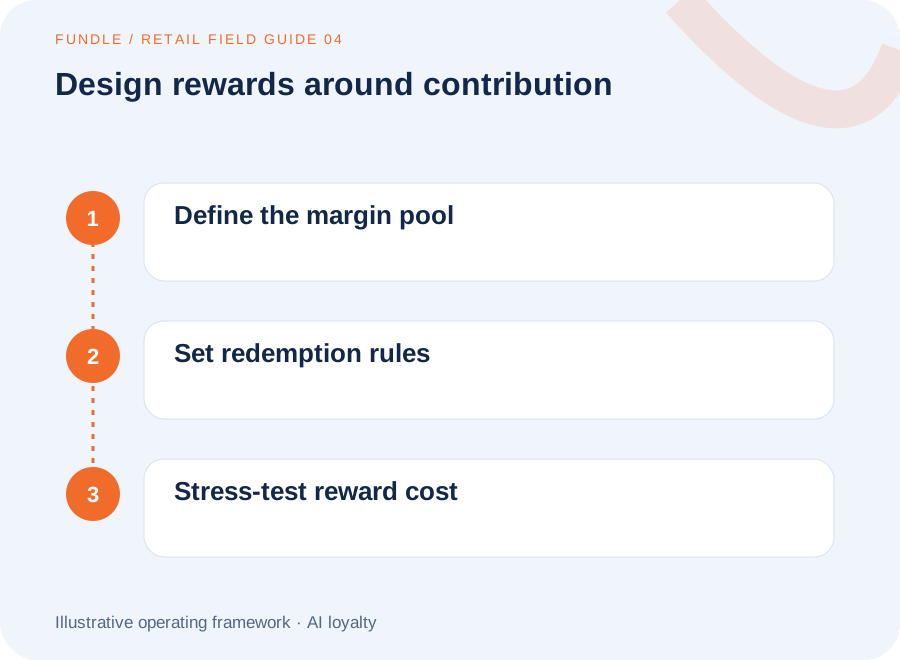
Design loyalty rewards around contribution, not redemption alone
How can a retailer design loyalty rewards without eroding margin?
Estimate the additional contribution a reward can create, then subtract its expected redemption, fulfilment and contact costs across all eligible customers. Check existing discounts, returns and product availability before approval. Compare the proposed reward with a no-additional-reward baseline. High redemption is useful operational information, but a reward succeeds commercially only when it changes behaviour enough to cover its costs.
Make the commercial question explicit
A reward can be popular and still be expensive. If customers who would have bought anyway redeem it, the programme pays for activity it did not create. Start with a precise objective: encourage a genuinely additional visit, support a relevant category purchase or recover an otherwise lost relationship. Avoid approving an offer solely because it produces a large redemption count.
Define the comparison as the existing customer experience without the additional reward. That baseline can already include standard loyalty benefits, normal discounts and service commitments. The proposed reward must be evaluated against those conditions, not against an imaginary full-price world that customers never experience.
Work on an agreed contribution basis
For operating decisions, contribution should reflect the sales amount retained after relevant product and variable costs. Agree the calculation with the retailer's finance team. Use consistent treatment of invoice discounts, returns, fulfilment, payment costs and reward expense. Do not mix tax-inclusive receipts with tax-exclusive product margins in the same calculation.
Shopify's profit-report documentation makes product cost data part of its profit reporting. Our recommendation is to go further for a campaign decision: maintain a clear list of the additional variable costs that the reward creates. Platform gross-profit reports and campaign contribution models may have different scopes.
A cash discount, a complimentary product and a service benefit have different economics. Use the actual incremental cost of providing the benefit, including handling where relevant. Do not value a complimentary item at its ticket price simply because that sounds impressive in the creative. Conversely, do not call a service free if staff time or delivery capacity becomes a binding constraint.
Review the full offer stack
A loyalty voucher may combine with a seasonal markdown, payment promotion, free shipping or store-manager discount. The headline reward value does not reveal the final basket economics. Test representative baskets across the channels where customers can redeem, including one item that should be excluded.
Shopify's discount-combination guidance distinguishes product, order and shipping discounts and their combination settings. This illustrates why checkout behaviour must be verified in the actual commerce configuration. Do not assume that POS and online checkout interpret every programme condition identically.
| Approval question | Evidence required | Operator decision |
|---|---|---|
| Who can redeem? | Eligibility snapshot and programme rules | Exclude ineligible audiences |
| What else can combine? | Tested basket and discount sequence | Allow or block the combination |
| What does fulfilment cost? | Product and service cost basis | Select a sustainable benefit |
| Is the item available? | Store or channel stock coverage | Limit geography or postpone |
| What happens after a return? | Approved reversal rule | Explain and implement the resolution |
| How will value be measured? | Comparison and cost definitions | Run a bounded test |
Worked hypothetical example: more orders, less contribution
Assume a retailer evaluates an additional voucher for 1,000 eligible customers. Without the voucher, the expected purchase probability is 20%, and each qualifying purchase contributes ₹300 before the proposed reward. Expected contribution per eligible customer is therefore 0.20 multiplied by ₹300, or ₹60.
The team hypothesises that an ₹80 voucher raises purchase probability to 25%. For this simplified example, every purchasing customer in the offer group redeems it, and every purchase otherwise has the same contribution. Expected contribution becomes 0.25 multiplied by ₹220, or ₹55. A further ₹2 contact cost per eligible customer reduces that to ₹53. Against the ₹60 baseline, the offer loses an expected ₹7 per eligible customer, or ₹7,000 across 1,000 customers.
The forecast has more purchases, yet worse economics. The voucher is paid on all 250 expected purchases, including purchases that might have happened anyway. Counting reward cost only against the 50 additional expected purchases would hide most of the subsidy.
Now consider a ₹40 voucher while temporarily keeping the same 25% purchase assumption. Expected contribution is 0.25 multiplied by ₹260, less ₹2, which equals ₹63 per eligible customer. That is ₹3 above baseline. This is a sensitivity calculation, not a prediction that the smaller voucher will preserve the same response. Its actual effect must be tested.
Design a test around the uncertain assumption
In the example, the most important unknown is how purchase behaviour changes at each reward value. Historical redemption does not directly estimate that change. A small comparison of eligible audiences can test the response while monitoring contribution and customer friction. Keep the baseline experience consistent and avoid comparing customers selected on different purchase propensities.
Review the result by pre-specified commercial segments only where the sample supports it. A reward may work in a replenishment category but fail on heavily marked-down products. Do not keep slicing a disappointing test until one tiny segment looks positive. Use the first test to identify a plausible next hypothesis, then validate it separately.
Manage promised value and redemption operations
Communicate eligibility, redemption channels, exclusions and validity in plain language before customers act. Commercial discipline should not create a confusing programme. If a benefit needs so many exceptions that staff cannot explain it, simplify the proposition or choose another benefit.
For points-based rewards, maintain issued, available, redeemed, expired and reversed movements separately. Expected redemption cost is a planning estimate and should be reconciled as actual behaviour emerges. This guide does not prescribe accounting treatment for loyalty obligations; finance owns that policy. Avoid improving an operating forecast simply by assuming customers will fail to use benefits that were presented as valuable.
Reward approval checklist
- Specify the customer behaviour the reward is intended to change.
- Approve the baseline and contribution definition with finance.
- Cost the reward across all expected redemptions, not only incremental orders.
- Test stacking, exclusions, partial returns and channel differences.
- Set a budget, stock boundary and accountable approval owner.
- Evaluate observed contribution and customer experience before expansion.
Discuss these controls through Loyalty and CLM and campaign management. Request a Fundle walkthrough using a real proposed reward and representative baskets. Ask which data, rules and human approvals the evaluation workflow would need before any offer is activated.
Questions from retail teams
Is a high redemption rate good or bad?
It depends on the objective and economics. High redemption can show that customers understand and value the benefit, but it also increases fulfilment cost. Compare contribution with the existing experience and examine whether behaviour changed. A low redemption rate is not automatically profitable either, because it may indicate a confusing or irrelevant programme.
Should complimentary products be costed at retail price?
For the operating contribution calculation, use the incremental cost of providing the product, including relevant handling and fulfilment. The advertised customer value is a separate concept. Confirm the cost basis with finance and consider stock opportunity cost where inventory is scarce. A high ticket price does not necessarily mean an equally high programme expense.
Why include reward cost on customers who would buy anyway?
Because those redemptions still reduce the contribution the business retains. The commercial comparison must include every relevant cost incurred by the offer group. If the reward also subsidises baseline purchases, that cost can outweigh the value from additional purchases. Ignoring those customers makes an expensive offer appear more efficient than it is.
Can we use expected point expiry to fund a richer programme?
Treat expiry assumptions cautiously and distinguish operational planning from accounting policy. Forecasts should be checked against actual cohorts and redemption conditions. Do not rely on customers misunderstanding or being unable to use a promised benefit. Review programme value, economics and communication together, with finance responsible for the treatment of outstanding obligations.
How should staff discounts interact with loyalty offers?
Define the combination explicitly and test it in the actual selling systems. Staff may have manual discount permissions that behave differently from standard promotion rules. Provide a short operating guide and an escalation route for unclear baskets. Record overrides so the commercial team can see whether unexpected combinations are changing reward costs.
Sources and further reading
- Shopify Help Center: Profit reports — Product cost data is relevant to documented profit reporting. Incremental contribution formulation and examples are original operating analysis.
- Shopify Help Center: Combining discounts — Documented distinction between product, order and shipping discount classes and configurable combination behaviour; no Fundle integration asserted.