MBO scheme and claims reconciliation: connect the promise, the sale and the deduction
How should brands reconcile MBO schemes and partner claims?
Reconcile an MBO claim against the approved scheme version, eligible transactions, exclusions and previous settlements. Separate the partner's requested amount from the calculated entitlement, approval and actual credit. Investigate differences with source evidence and preserve partial resolutions. This creates an auditable commercial workflow without assuming every deduction is invalid or every accrued incentive is already paid.
Convert the commercial promise into a testable rule
A scheme can sound simple in a sales conversation and become ambiguous when a partner deducts it from payment. Was the incentive based on purchases into the outlet, consumer sell-through, a volume threshold or a display commitment? Which products, stores and dates qualified? Reconciliation begins with those definitions, not with the deduction amount.
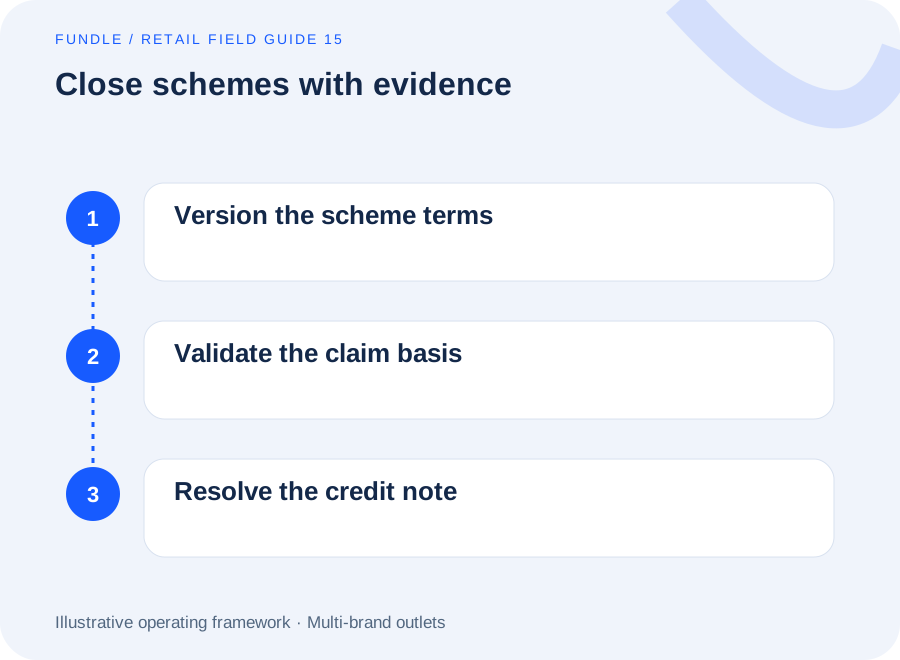
Maintain an approved scheme record containing the commercial owner, partner scope, eligible event, calculation basis, effective period, exclusions, caps and required evidence. Preserve amendments as new versions. The team should be able to explain why a specific transaction qualified under the version effective at that time.
Distinguish entitlement, claim and settlement
The calculated entitlement is the amount supported by the scheme and eligible activity. A claim is what the partner requests. Approval is an internal decision. Settlement is the actual credit, payment or other agreed resolution. These stages can have different amounts and dates.
Oracle's customer accrual documentation treats incentive accrual and claim settlement as separate processes. This article applies that distinction as an operating control, not as a prescription for accounting entries or a claim about a Fundle integration.
| Record | Essential evidence |
|---|---|
| Scheme | Approved rules, period and version |
| Eligible activity | Invoice or consumer-sale lines, returns and exclusions |
| Entitlement | Reproducible calculation and remaining cap |
| Partner claim | Reference, requested amount and supporting documents |
| Resolution | Approval, rejection or partial decision with reason |
| Settlement | Credit or payment reference and residual balance |
Build the claim around identifiable transactions
Require a partner claim reference and link it to invoices, consumer transactions or other agreed evidence. Where a claim covers multiple periods or schemes, split its lines without losing the parent reference. Keep tax and commercial amounts on the basis approved by finance rather than mixing gross and net figures.
Oracle's claim investigation guidance documents reasons and references for investigating short payments. Your operating queue should similarly distinguish pricing errors, promotional claims, shortages and damage. Different reasons require different evidence and should not all be cleared against a promotional budget.
A deduction can be legitimate but poorly documented. Conversely, complete paperwork does not establish that the calculation is correct. Verify both the evidence and the commercial rule.
Worked hypothetical example: reconcile the remaining entitlement
Assume a partner has an approved 5% incentive on eligible net purchases during a month. The simplified example uses amounts excluding taxes, with no thresholds or caps. Purchases total ₹5,00,000, qualifying returns total ₹50,000 and excluded products total ₹1,00,000.
Eligible value is ₹5,00,000 − ₹50,000 − ₹1,00,000 = ₹3,50,000. Entitlement is 5% × ₹3,50,000 = ₹17,500. A previous credit of ₹5,000 has already settled part of that same entitlement, leaving ₹12,500 outstanding.
The partner now deducts ₹20,000. The unexplained excess over remaining entitlement is ₹20,000 − ₹12,500 = ₹7,500. Investigate whether the partner used a different period, omitted exclusions or included another agreed scheme. Do not reject the whole ₹20,000 merely because part is unsupported.
If a later approved amendment adds ₹2,000 of entitlement, update the versioned calculation and residual difference. Preserve the earlier result and the reason for revision so neither side loses the audit trail.
Handle thresholds and reversals explicitly
Schemes with slabs need a clear rule: does the higher rate apply to all eligible value or only the incremental band? A volume threshold may use units while the payment uses value. Document how returns after the scheme period affect achievement and whether the agreement permits later adjustment.
Avoid applying a current scheme version to historical claims. Test boundary cases before use: exactly at the threshold, just below it, returned quantities, excluded variants and partially fulfilled orders. These checks reveal ambiguities before they become partner disputes.
Prior credits should reduce only the entitlement they actually settled. A general account credit with no scheme reference may require investigation rather than automatic netting.
Organise evidence and approval around the dispute
Assign one claim owner to coordinate sales, trade marketing, operations and finance. Give each unresolved line a reason, evidence request, next action and review date. Capture partner correspondence as evidence, but do not let a verbal agreement silently replace the approved commercial record.
Set tolerances through an authorised policy. Small rounding differences may be handled differently from recurring calculation errors. Any accepted variance needs a reason and approver so repeated exceptions can be analysed rather than hidden in write-offs.
Distinguish claimed, supported, approved, settled and outstanding values on the dashboard. Reporting all closed cases as recovered money creates a misleading performance story, especially when closure includes acceptance or rejection without cash movement.
Practical month-end checklist
Confirm that the scheme version is approved, the qualifying period is complete and returns are included on the agreed basis. Reconcile transaction totals to source files. Check caps, prior credits, duplicates and overlapping scheme eligibility. Review pending evidence separately from rejected claims.
Select a sample with a partial credit and reproduce its remaining entitlement. Ensure the next period carries forward only the unresolved balance. A good close leaves the partner account and the scheme record telling the same story.
Evaluate with a real commercial example
Bring an approved scheme, a redacted partner claim and a previous credit to a MBO workflow walkthrough. Ask how a proposed Fundle Brain interface would show the rule, evidence and next approval. Establish the commercial and data requirements first; do not assume a particular ERP connection or automatic settlement capability.
Questions from retail teams
What is the difference between a scheme accrual and a claim?
An accrual represents an estimated or calculated incentive obligation under the organisation's accounting and commercial process. A claim is the partner's request for compensation or credit. They can differ because of timing, eligibility or calculation. Reconcile both to the approved scheme and let finance determine the appropriate accounting treatment.
How should we handle a claim that is partly correct?
Split the claim into supported and unresolved components while preserving its original reference. Record the basis for any partial approval and the amount actually settled. Continue investigating the residual balance. Rejecting or accepting the whole claim can obscure a valid entitlement and make later credits harder to match.
Can sales approve a scheme change retrospectively?
That depends on the organisation's authority policy and the commercial agreement. The reconciliation workflow should require an authorised amendment with its effective scope and reason. Preserve the original calculation and show the revised entitlement separately. A conversational assurance should not silently overwrite a rule that finance and the partner previously relied on.
How do we prevent the same sale earning duplicate incentives?
Define whether schemes can overlap and apply that rule at transaction level. Keep a link between each eligible event and every entitlement it generates. Review overlapping periods, duplicate partner submissions and prior credits. If overlap is contractually allowed, record it explicitly rather than treating every repeated transaction as an error.
Which metrics help manage the claims backlog?
Track requested value, supported value, unresolved balance, case age, evidence waiting time and the distribution of reasons. Show partial settlements separately. Measure recurring root causes such as unclear scheme rules or missing transaction references. A high closure count is insufficient if large residual balances or repeated disputes remain unresolved.
Sources and further reading
- Oracle: How Customer Accruals are Accounted — Accrual and claim settlement are separate documented steps; article is operational guidance, not accounting advice.
- Oracle: Create Claim Investigations — Documented claim investigation references, reasons and short-payment examples; no Oracle integration claim.