EBO clienteling with AI recommendations: from suggestion to useful service
How should EBO teams use AI recommendations for clienteling?
Use AI recommendations as preparation for an associate’s conversation, grounded in permitted purchase history, current product information and the shopper’s expressed need. Separate a suggested product from confirmed stock, an inferred preference from a customer choice, and an assisted sale from proven incremental impact. Evaluate the recommendation, the handover and the final customer outcome as separate stages.
Start with the service moment
Clienteling is useful when the associate remembers the right context and helps the customer decide. A recommendation that ignores fit, a recent return or the shopper’s stated budget creates extra work. Start with one service moment: preparing for an appointment, finding a complementary category, explaining a new collection or helping a customer continue an earlier enquiry.
Define what the associate should do differently after receiving the suggestion. A ranked product list is not enough. The output should explain why an item is relevant, which facts support the suggestion and what still needs confirmation. Keep the shopper’s current request ahead of a historical pattern.
Build a small, dependable context set
The Shopify POS customer-management documentation describes profiles holding contact details, purchase history and preferences. That is a concrete example of potentially useful clienteling context, not evidence that another product has access to those records. Confirm the actual source, permission and refresh method in your environment.
A first EBO pilot needs reliable customer matching, recent purchases and returns, an approved product master, store context and the relevant communication choice. Add size or fit preferences only when their source is clear. Do not turn a gift purchase into a permanent personal preference. Preserve whether information came from the customer, a transaction or an inference.
Record the age of stock and price information. If live availability is absent, the associate should confirm it before making a promise. A confident recommendation of an unavailable item is not a successful customer interaction.
Separate the recommendation layers
| Layer | Example | What the associate should verify |
|---|---|---|
| Customer statement | Needs comfortable formal footwear | Confirm the current occasion and requirement |
| Observed history | Purchased one category previously | Check returns, gifts and identity reliability |
| Product fact | Material or care instructions | Use an approved, current product source |
| Suggested relevance | Another item may suit the occasion | Explain the reason without presenting certainty |
| Commercial condition | Price, benefit or collection option | Confirm the current offer and store capability |
| Contact decision | Send an appointment reminder | Check the relevant permission and customer preference |
This structure makes review practical. The associate can correct a weak assumption without discarding the useful parts of the suggestion. Capture correction reasons in simple language so product and data teams can address the underlying issue.
Design the associate workflow
- Retrieve the correct customer context through an approved identification process.
- Restate the current need, budget or occasion without adding unnecessary personal questions.
- Review a short suggestion set with visible product reasons and source freshness.
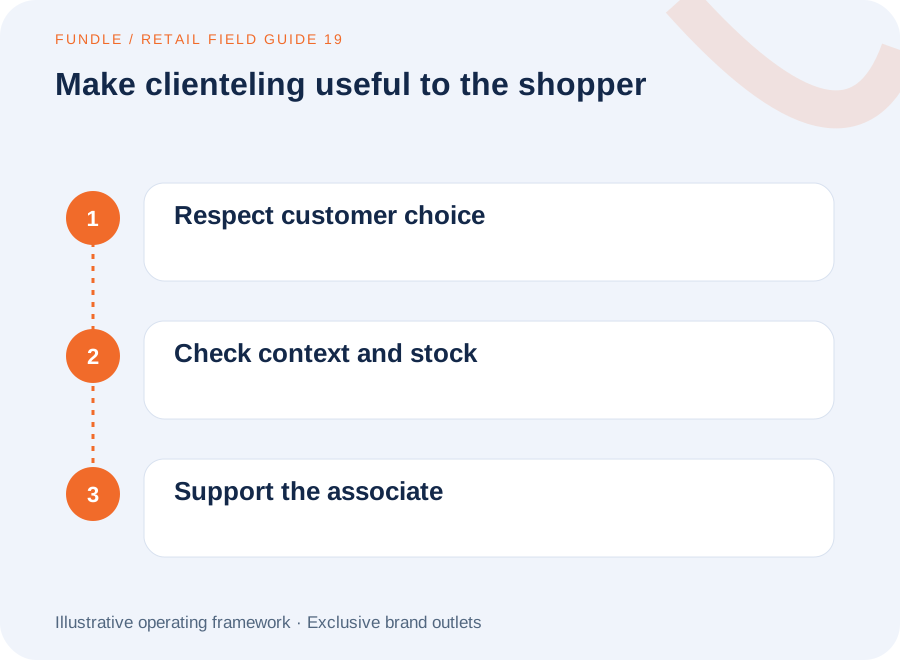
- Confirm fit, stock, price and service terms through the appropriate source.
- Offer the recommendation in ordinary service language and let the customer choose.
- Record the outcome: useful, unsuitable, unavailable, purchased, deferred or escalated.
Do not require the associate to copy long generated paragraphs into a live conversation. A concise briefing is usually easier to inspect. Separate internal reasoning notes from customer-facing wording, particularly where an inference could feel intrusive or simply be wrong.
A worked hypothetical pilot
Suppose 120 eligible appointments are randomly assigned before the visit: 60 receive an associate briefing based on an evaluated recommendation process and 60 continue with the existing service approach. Assume comparable staffing, category availability and follow-up windows. In the briefing group, 24 customers complete a qualifying purchase; in the comparison group, 18 do.
The observed purchase rates are 24 ÷ 60 = 40% and 18 ÷ 60 = 30%. The difference is 10 percentage points, or an estimated six additional purchasers across 60 assigned appointments under the comparison assumptions. This small illustration does not establish statistical reliability or predict a rollout result.
If contribution before briefing costs is ₹12,600 in the treatment group and ₹9,000 in the comparison group, the observed difference is ₹3,600. If the additional preparation cost is ₹1,200, the illustrative net difference is ₹2,400. Include every assigned appointment under the predefined outcome rules; do not analyse only customers who accepted the suggestion. Record cancellations and missing outcomes explicitly.
Measure recommendation quality before sales uplift
Track whether the right customer was selected, whether the product facts were correct, whether the item was available and whether the associate found the suggestion useful. Review unsuitable recommendations by reason: wrong occasion, stale inventory, implausible price band, duplicated item or insufficient knowledge. These findings can improve the workflow even before a commercial experiment is large enough to interpret.
The NIST AI Risk Management Framework is a voluntary framework concerned with trustworthiness across AI design, use and evaluation. Applying that principle here is an editorial recommendation: evaluate the complete service workflow, including the associate’s ability to challenge the output, rather than scoring generated text in isolation.
Give the team permission to disagree
An associate should be able to reject a suggestion and continue serving the customer. Do not turn acceptance rate into a target that encourages forced recommendations. Inspect whether a rejected suggestion was actually poor or whether the employee needed better product context. Both are useful learning signals, but they require different interventions.
Keep personal notes relevant to the service. Avoid storing speculative judgments about wealth, health or personal circumstances. A stated preference for a product feature can be useful; a guessed explanation about the customer’s life is usually unnecessary for choosing the next retail action.
Pilot readiness checklist
Confirm the eligible service moment, customer-matching method, product source, availability check, associate owner and escalation path. Test a gift purchase, a recent return, a changed preference and an unavailable size. Decide how corrections reach the next suggestion. Train the team to distinguish a proposed recommendation from an approved offer and a confirmed reservation.
Agree the comparison design, completed-order definition and return window before launch. Observe a representative mix of associates and stores instead of selecting only enthusiastic early users. Review customer questions and service friction alongside sales outcomes.
Explore enterprise retail knowledge and lead-to-store handovers, then request a Fundle workflow walkthrough around one clienteling appointment. Ask which context is actually connected, how an associate reviews the suggestion and what is recorded after the visit. Confirm those capabilities in the proposed deployment before setting operating targets.
Questions from retail teams
What is the difference between clienteling and a product recommender?
A recommender proposes items or content. Clienteling includes the associate, the customer’s current need, product clarification, store availability, service promises and follow-through. Evaluate whether the recommendation improves that whole interaction. A technically plausible product match can still be poor service when it ignores timing, fit or a recent issue.
Should an associate tell the customer why an item was recommended?
Give a useful, ordinary explanation based on the current request or an appropriate known preference. Avoid revealing unnecessary internal data or presenting an inference as a fact about the customer. The associate should be able to explain the product’s relevance and invite correction without sounding like a profiling system.
Can a previous size purchase be treated as the customer’s current size?
Treat it as context, not certainty. The purchase might have been a gift, a different product fit or an item later returned. Ask the relevant fit question when it matters. Preserve whether the size was explicitly confirmed by the customer and when that information was last updated.
How do we test clienteling when the store network is small?
Begin with recommendation-quality and service-process checks, then design a comparison that fits your appointment volume. Random assignment can help, but contamination across associates and uneven product availability need attention. Report uncertainty honestly. A short pilot can expose operating problems without proving a commercially reliable sales effect.
Should recommendation acceptance become an associate incentive?
Avoid rewarding acceptance alone because it can encourage associates to use unsuitable suggestions. Assess service quality, factual correctness, customer feedback and completed outcomes together. Rejections with clear reasons are valuable evidence. A good operating process lets the associate challenge the recommendation while preserving accountability for the next service step.
Sources and further reading
- Shopify POS customer management — Documents purchase history and preferences in Shopify customer profiles; used as a source-context example, not Fundle feature evidence.
- NIST AI Risk Management Framework — Voluntary trustworthiness and lifecycle evaluation context. The clienteling workflow and pilot design are original recommendations.