A marketplace intelligence morning brief that leads to accountable decisions
What should a marketplace super intelligence morning decision brief include?
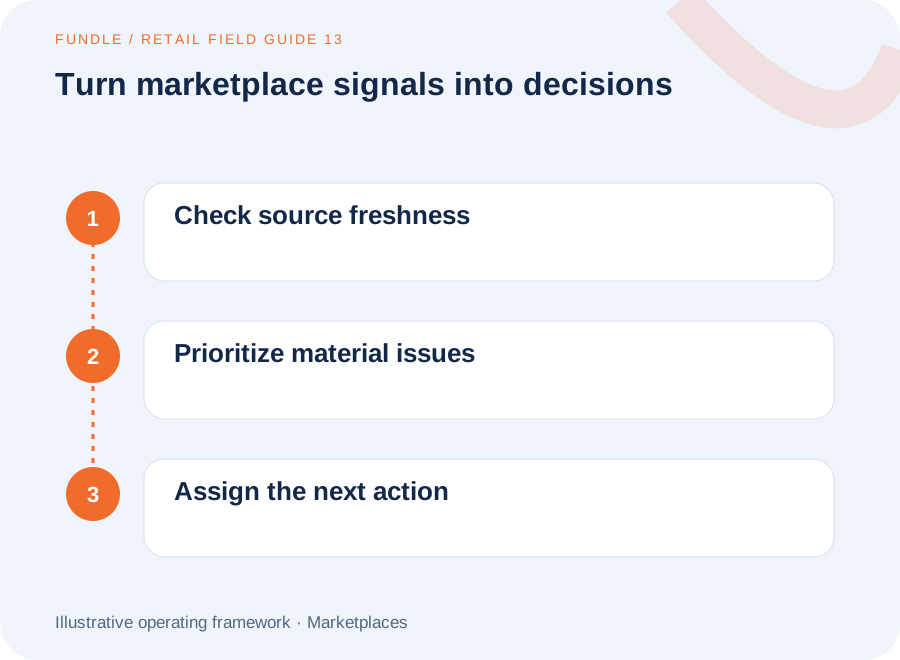
A useful marketplace morning brief shows a small set of material exceptions, the evidence behind each one, its commercial exposure and the next accountable action. Include data freshness, confidence, constraints and approval needs. Treat super intelligence as an operating ambition: recommendations should support human decisions, with execution permissions and outcome measurement explicitly defined.
Replace the report pile with a decision contract
A daily brief should help the marketplace team decide what needs attention before the next trading window. More charts do not automatically improve that decision. Begin by defining the meeting's scope: which accounts, categories, stock pools and financial periods it covers, who can approve actions and which systems remain the record of execution.
Super intelligence is a useful ambition only when translated into inspectable work. A recommendation should show what changed, why it matters, what is uncertain and what action is proposed. It should not imply that an AI system can reliably make every commercial decision or execute without constraints.
Establish a data readiness gate
Before ranking opportunities, show the latest successful update for orders, inventory, returns, settlement and advertising. Record expected coverage and missing accounts. A fresh dashboard built on a stale stock file is not a fresh view of availability.
Shopify's inventory-state documentation distinguishes quantities that are physically held from quantities available to sell. That is an example of a definition the brief must preserve. Do not recommend advertising or replenishment from an undifferentiated stock total.
The readiness gate should produce three outcomes: usable for decision, usable with a visible qualification, or blocked pending evidence. A blocked data source deserves an owner and resolution action. It should not be converted into a confident trading insight.
Give every item the same evidence structure
| Brief field | What the operator needs |
|---|---|
| Signal | Specific account, variant and change |
| Evidence | Source records, comparison and freshness |
| Exposure | Rupees, units or service risk with assumptions |
| Proposed action | A concrete reversible next step where possible |
| Constraints | Stock, budget, contract and approval limits |
| Owner and review | Responsible person and outcome checkpoint |
Keep the queue short enough for decisions, while retaining a searchable backlog. Distinguish financial discrepancies from demand signals and data-quality failures. A missing settlement row, a stockout risk and a falling conversion rate call for different evidence and cannot sensibly share one unexplained score.
Compare equivalent populations
A day-to-day sales decline can reflect a promotion ending, fewer available variants or a reporting cutoff. Set the comparison before diagnosing the cause. Use consistent accounts, trading hours and product populations, and identify calendar or campaign changes that make the comparison imperfect.
For cash issues, use the settlement period and eligible events. Amazon's settlement report schema separates settlement identifiers and posting dates, reinforcing that a payout question has its own timeline. Do not place yesterday's order sales beside today's bank deposit and call the difference a daily loss.
Show the denominator behind every rate. Five late orders out of ten is a different operating situation from five out of ten thousand, even though both may require individual resolution.
Worked hypothetical example: choose the next investigation
Suppose the team has three candidates. SKU A may run out before replenishment arrives; the planner estimates 20 otherwise retained units at ₹250 contribution each, giving ₹5,000 of potential exposure. Settlement B has a documented ₹12,000 unexplained difference. Campaign C offers a speculative ₹8,000 improvement based on incomplete attribution.
These figures are not additive profit opportunities. The ₹5,000 depends on demand and supply assumptions. The ₹12,000 is disputed cash, not proven recoverable profit. The ₹8,000 is an unvalidated estimate. The brief should make those distinctions visible.
Assume A needs a decision today, B has a documented evidence deadline tomorrow, and C can wait. Assign operations to verify a stock transfer for A, finance to complete B's evidence pack and marketing to investigate C's measurement. The best morning plan is three accountable next steps, not automatic execution of the largest number.
Define approval before proposing execution
Specify who can alter price, pause advertising, move stock or submit a claim. Thresholds should reflect the organisation's rules and reversibility, not a model's apparent confidence. An approved recommendation should generate a traceable task or action record with scope, timestamp and authorisation.
Where an execution connection is absent, the correct output is a clear handover. Where a source is unreliable, the correct output may be a request for evidence. Both are useful outcomes. Claiming completion when the system only drafted a recommendation damages the operating record.
For repeated tasks, evaluate automation only after the team understands the exceptions and can check whether the action succeeded. Preserve a way to stop, reverse or escalate within the capabilities of the actual system.
Close the learning loop without inventing causality
At the next review, mark actions as completed, rejected, blocked or awaiting outcome. Record the reason. Compare observed results with the original expected effect, including costs and unintended consequences. A sales increase after an action does not by itself prove that the action caused it.
Track decision latency, unresolved exposure, task completion and recurring data failures. Pair these process measures with commercial outcomes. Faster decisions are useful only if they improve the work rather than accelerate avoidable mistakes.
Practical meeting checklist and evaluation
Before the meeting, confirm coverage and definitions. During it, assign one owner and next checkpoint to each accepted item. Afterwards, retain the evidence snapshot and decision rationale. Remove resolved items from the active queue without deleting their history.
Bring a sample morning meeting to a marketplace workflow walkthrough and evaluate Fundle Brain as a retail decision interface. Ask how it would present these evidence and approval requirements. This operating framework describes what to assess; it does not promise autonomous marketplace management or a particular live integration.
Questions from retail teams
How many items should the morning brief contain?
Use the number the team can actually decide and assign within its meeting, rather than a fixed universal target. Keep supporting detail and the remaining backlog accessible. If every item is urgent, review the thresholds and ownership model. The brief should clarify priorities without hiding unresolved risks that still require monitoring.
Should we rank every issue by estimated rupee value?
Rupee exposure helps but is insufficient. Include urgency, evidence quality, customer impact, reversibility and documented deadlines. Separate potential contribution, disputed cash and hypothetical opportunity because they are not equivalent amounts. An imminent evidence deadline or unreliable data feed may deserve attention before a larger but weakly supported growth estimate.
What does confidence mean in this workflow?
Confidence should describe the evidence and assumptions behind a recommendation: source coverage, freshness, sample size, matching quality and stability of the comparison. It should not be an unexplained percentage that users treat as certainty. State what additional information could change the recommendation and when the decision should be deferred.
Can AI execute actions from the brief automatically?
Only where an actual implementation supports the action and the organisation has defined permissions, limits, monitoring and exception handling. Some recommendations require human approval or manual execution. Evaluate each workflow separately. The morning-brief framework does not establish that Fundle or any connected marketplace already provides autonomous execution capabilities.
How do we know whether the brief is improving operations?
Track whether accepted items receive owners, whether evidence is complete, how quickly decisions are made and whether recurring exceptions decline. Then examine commercial outcomes with appropriate comparisons and costs. Do not count more generated recommendations as success; a smaller queue with reliable follow-through can be more useful than a large volume of alerts.
Sources and further reading
- Shopify: Understanding inventory states — Documented distinction between stock states; proposed cross-partner operating controls are editorial.
- Amazon Selling Partner API: Settlement Reports — Documented settlement fields and V2 amount classifications; broader reconciliation workflow is editorial recommendation.