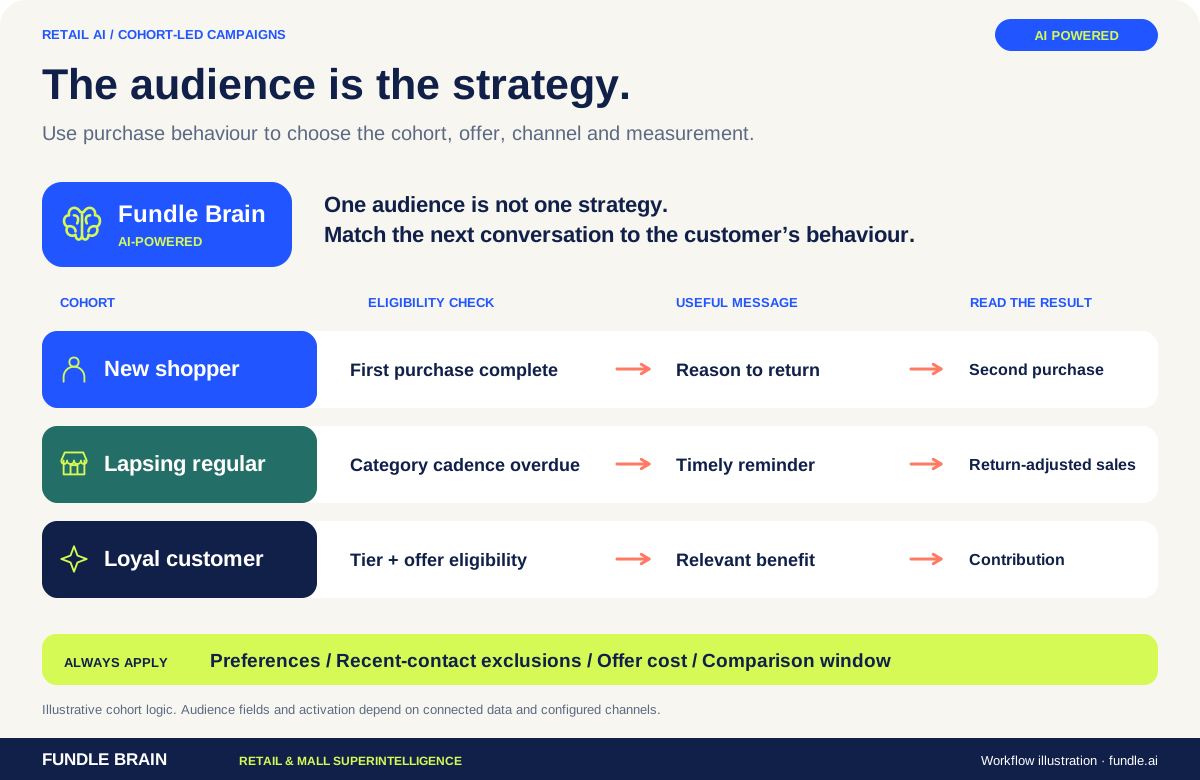

A customer purchasing after a message does not prove that the message caused the purchase. Incrementality asks how the campaign changed behaviour relative to a credible comparison.
Choose the outcome before sending
Define orders, revenue or contribution margin over a fixed measurement window. Decide how returns, cancellations and repeat orders will be treated.
Create a comparable holdout
Where practical, randomly assign an eligible audience into campaign and holdout groups before activation. Keep eligibility rules and observation windows consistent.
Compare rates, not raw totals
If the groups have different sizes, compare per-customer rates. Incremental conversion is the campaign conversion rate minus the holdout conversion rate; uncertainty matters, especially with small samples.
Bring economics into the result
Include discount, reward, media and messaging costs. Revenue lift alone cannot establish whether a campaign added profit.
Document the limitations
Stock changes, overlapping campaigns and channel spillover can affect interpretation. Report the design and caveats alongside the result so the next experiment can improve.
Define the unit before the experiment
Choose whether randomisation and measurement happen at customer, household or store level. Avoid splitting records that refer to the same person across treatment and holdout. Decide eligibility, exclusions and the analysis period before sending the message.
Measure everyone assigned
Include all eligible people assigned to each group, including those who did not open or click. Restricting analysis to responders selects for behaviour influenced by the campaign. Keep overlapping campaigns and store interventions visible when interpreting results.
Follow contribution, not only revenue
Return-adjusted incremental sales are a useful start. Deduct the relevant product, offer, reward and communication costs to understand contribution. A redemption count or attributed order count alone does not establish that the campaign caused an incremental sale.
Make the learning operational
Document the audience definition, creative, offer, timing and measurement result together. A weak result should inform the next audience or proposition. A strong result still needs a review of margin, opt-outs and repeat behaviour before a larger rollout.
Put the guide to work.
Map the principle to your own data and operating process.
Explore the related workflowFundle editorial · Updated 12 October 2026 · Practical guidance; examples are illustrative.